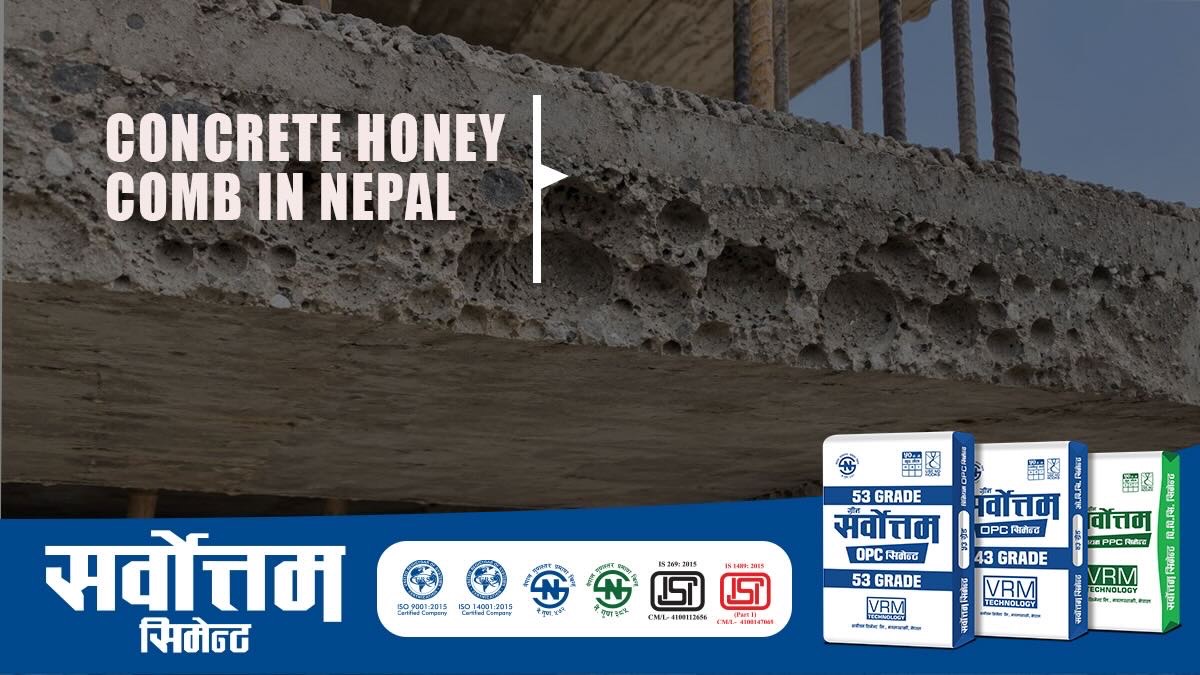
Concrete Honeycombing in Nepal: Causes, Prevention, and Repair of Weak Concrete
Concrete is one of the most important construction materials in Nepal. From residential houses and commercial buildings to roads, bridges, and infrastructure projects, concrete provides the strength and stability required for long-lasting structures. However, concrete quality depends on more than the cement used. Aggregate grading, water content, mix proportions, placement, compaction, formwork, and curing all influence the final result.
One common construction defect is concrete honeycombing. It occurs when cavities and voids remain in hardened concrete, often leaving coarse aggregates exposed. While minor surface honeycombing may affect appearance, deeper defects can compromise concrete cover, expose reinforcement, allow moisture penetration, and affect structural durability.
For homeowners, contractors, engineers, and builders, understanding the causes of honeycombing is essential to preventing weak concrete and maintaining construction quality.
In this guide, we explain what concrete honeycombing is, why it occurs, how to identify it, and the correct ways to prevent and repair it. We also discuss cement selection, Nepal's construction conditions, and how Sarbottam OPC 43 Grade, OPC 53 Grade, and PPC cement fit into a quality-focused construction process.
What Is Concrete Honeycombing?
Concrete honeycombing is a defect in hardened concrete characterized by irregular cavities, voids, and gaps between aggregate particles. It often resembles a honeycomb, with small holes and exposed coarse aggregates visible on the concrete surface.
Honeycombing commonly occurs in reinforced concrete structures such as:
- Columns and beams
- Beam-column joints
- Roof slabs
- Concrete walls
- Foundations and footings
- Staircases and other reinforced concrete components
The severity of honeycombing can vary. Shallow surface voids may primarily affect the appearance of concrete. However, deeper cavities can reduce the effective concrete section, expose reinforcement, and allow water and other harmful substances to penetrate more easily.
The actual impact depends on the location, depth, extent, reinforcement condition, and design requirements of the affected structural member. A visual inspection alone cannot reliably establish whether the concrete retains its required structural strength.
What Causes Honeycombing in Concrete?
Honeycombing usually results from problems with concrete materials, mix design, placement, formwork, or compaction. Several factors may contribute to the same defect.
1. Improper Concrete Compaction
Inadequate compaction is one of the common causes of honeycombing.
Fresh concrete contains entrapped air. If it is not properly consolidated, air pockets may remain between aggregate particles and around reinforcement bars. These pockets can become visible cavities after the concrete hardens.
Mechanical concrete vibrators are commonly used to consolidate fresh concrete and help it fill the spaces within formwork. However, vibration must be appropriate for the concrete mix and placement conditions.
Insufficient vibration can leave voids, while improper vibration may contribute to segregation or disturb reinforcement and formwork.
Prevention tip: Use suitable compaction equipment, train workers in its correct operation, and follow the approved concreting procedure.
2. Poor Concrete Mix Proportioning
Concrete requires a suitable balance of cementitious materials, fine aggregate, coarse aggregate, and water.
An unsuitable mix may not flow adequately around reinforcement or fill the formwork. Poor aggregate grading or insufficient mortar content can also make consolidation difficult.
Simply adding more cement does not guarantee stronger concrete or eliminate honeycombing. The mix should be designed or selected according to the required concrete strength, workability, exposure conditions, aggregate properties, and project specifications.
3. Incorrect Water-Cement Ratio
Water is necessary for cement hydration and provides the workability needed to place concrete.
Excessive water can reduce concrete strength and increase the risk of segregation, bleeding, and durability problems. On the other hand, concrete that is too stiff may be difficult to place and compact, particularly around congested reinforcement.
Adding water indiscriminately at the construction site is not a reliable solution. Workability should be controlled through an appropriate mix design and approved methods, including suitable admixtures where specified.
4. Poor Aggregate Quality or Grading
Concrete contains aggregates of different sizes that must be proportioned appropriately.
Poorly graded aggregates, excessive oversized particles, contaminated sand, or unsuitable aggregate characteristics can make concrete difficult to place and compact. If coarse aggregates separate from the surrounding mortar, voids may remain in the hardened concrete.
Use clean, properly graded aggregates that meet project specifications and are suitable for the intended concrete application.
5. Congested Reinforcement
Reinforced concrete columns, beams, and joints may contain closely spaced steel bars. When reinforcement is congested, concrete may struggle to pass through the available spaces.
If the mix cannot flow and consolidate adequately, cavities may form behind or between reinforcement bars.
Prevention requires appropriate reinforcement detailing, suitable aggregate size, adequate workability, proper concrete cover, and a planned placement and compaction procedure. Any change to structural reinforcement or detailing must be approved by the responsible structural engineer.
6. Leaking or Poorly Sealed Formwork
Formwork holds fresh concrete in its required shape until it gains sufficient strength.
If formwork joints are poorly sealed, cement paste and mortar may escape during placement. Coarse aggregates can remain behind without enough surrounding mortar, producing honeycombing.
Before pouring concrete, inspect formwork joints, supports, alignment, cleanliness, and overall stability. Properly assembled formwork helps prevent leakage and maintains the required shape of the structural member.
7. Improper Concrete Placement
Concrete must be placed in a controlled manner so that it reaches every part of the formwork without excessive segregation.
Dropping concrete from an unsuitable height, placing it unevenly, or allowing aggregate to separate from the mortar can create non-uniform concrete.
Concrete should be deposited in a planned sequence and consolidated before placement conditions compromise its workability or the required bond between successive placements.
8. Inadequate Construction Supervision
Poor planning and inadequate site supervision can allow problems with material proportions, water addition, formwork, reinforcement placement, and compaction to go unnoticed.
A construction quality-control plan should identify responsibilities for checking materials, approving the mix design, inspecting reinforcement and formwork, monitoring placement, and verifying curing.
These checks are particularly important for structural members where defects may be difficult to assess after the concrete hardens.
How to Identify Honeycombing in Concrete
Honeycombing is often noticed after formwork is removed. Early inspection allows the construction team to document the defect and determine whether further investigation is necessary.
Common signs include:
- Irregular cavities or holes on the concrete surface
- Coarse aggregates exposed without sufficient surrounding mortar
- Rough, porous areas resembling a honeycomb
- Voids around reinforcement bars or near beam-column joints
- Poorly formed concrete at edges and corners
- Localized areas where the concrete appears incomplete
Not every rough surface is evidence of serious honeycombing. The defect may be superficial or extend deeper into the member.
If honeycombing exposes reinforcement, occurs at a structural joint, extends deeply into a beam or column, or appears extensive, consult a qualified structural engineer. Do not cover the defect with plaster or mortar before its extent has been assessed.
Honeycombing vs. Other Concrete Defects
Honeycombing is different from other concrete defects, although several may occur together.
- Honeycombing: Cavities with exposed aggregates, usually associated with poor consolidation, unsuitable workability, or mortar leakage.
- Plastic shrinkage cracking: Cracks that develop while concrete is still fresh, often because of rapid surface moisture loss.
- Segregation: Uneven distribution of aggregate and mortar, resulting in non-uniform concrete.
- Surface scaling: Flaking or peeling of the concrete surface.
- Spalling: Concrete breaking away in pieces, potentially due to reinforcement corrosion, impact, or other deterioration mechanisms.
Correct identification matters because different defects require different preventive measures and repair methods.
How to Prevent Honeycombing in Concrete
Preventing honeycombing starts before concrete is poured. Appropriate materials, a suitable mix design, properly prepared formwork, skilled workers, and systematic quality control all contribute to better results.
1. Choose Quality-Assured Cement and Materials
Cement binds fine and coarse aggregates together to form concrete. Its quality and consistency are important, but cement must be considered alongside all other ingredients.
Choose cement that meets the applicable product standards and is suitable for the intended construction application.
Sarbottam Cement is Nepal's most selling cement, the choice of more experts across Nepal. It offers OPC 43 Grade, OPC 53 Grade, and PPC cement options for different construction requirements. The appropriate product should be selected according to the approved mix design, relevant product specifications, and guidance from the project engineer.
Explore Sarbottam OPC Cement and Sarbottam PPC Cement to understand the available cement options.
Quality concrete also requires suitable aggregates, appropriate water content, and correctly proportioned materials.
2. Follow the Approved Concrete Mix Design
The concrete mix should meet the specified strength, workability, durability, and exposure requirements.
Avoid relying on arbitrary cement-to-sand-to-aggregate ratios for structural work. Increasing the cement content without proper mix design is not a substitute for correct proportioning.
For beams, columns, slabs, and foundations, follow the project specifications and the mix design approved by the responsible engineer.
3. Inspect Formwork Before Pouring
Before placing concrete, verify that:
- Formwork joints are adequately sealed.
- Supports and connections are secure.
- The formwork is correctly aligned.
- Debris and unwanted standing water are removed as required.
- Reinforcement is correctly positioned and adequately supported.
- Concrete can be placed and compacted throughout the member.
These checks help prevent leakage, displacement, and inaccessible voids.
4. Compact Concrete Properly
Use suitable mechanical vibration or another approved consolidation method.
Pay particular attention to corners, narrow sections, congested reinforcement, and beam-column joints. Operate vibrators according to the equipment manufacturer's instructions and the approved construction procedure.
Avoid relying on vibration alone to move concrete long distances through the formwork. The goal is to remove entrapped air and consolidate concrete without causing segregation or disturbing reinforcement.
5. Place Concrete in a Controlled Manner
Concrete should be placed in a planned sequence that allows each section to be filled and consolidated appropriately.
Avoid uncontrolled dropping, excessive movement of concrete after placement, and delays that interfere with the required bond between successive placements.
For large pours and complicated structural members, plan the placement sequence in advance. For additional guidance, read Precautions to Take While Concreting Beams and Columns.
6. Maintain Proper Curing
Curing helps concrete retain the moisture and temperature conditions needed for cement hydration and strength development.
After placement and finishing, protect the concrete against premature moisture loss and adverse environmental conditions. For many construction projects in Nepal, maintaining proper curing for at least 14 days is a practical recommendation, subject to the cement type, weather, project specifications, and engineer's instructions.
Proper curing supports concrete strength and durability, but it cannot correct honeycombing that has already formed because of poor compaction or leaking formwork.
Learn more about the role of curing in concrete and how long concrete should be cured.
7. Inspect Concrete After Formwork Removal
Once the formwork is removed at the appropriate time, inspect the exposed concrete surface.
Look for voids, exposed reinforcement, cracks, segregation, and other signs of poor consolidation. Document defects and report them to the site engineer.
Determine the extent and cause of any defect before selecting a repair method. Early assessment can prevent superficial repairs from concealing more serious problems.
How to Repair Honeycombing in Concrete
The correct repair method depends on the depth and extent of honeycombing and whether the defect affects structural performance.
Step 1: Assess the Defect
Inspect the affected area to determine its location, approximate extent, depth, and proximity to reinforcement.
For potentially structural defects, a qualified engineer may recommend additional investigation or testing.
Step 2: Remove Loose or Unsound Material
Where a repair is approved, loose concrete and unsound material must be removed using a method appropriate for the defect and structural member.
Care must be taken not to damage reinforcement or unnecessarily weaken the surrounding concrete.
Step 3: Prepare the Repair Area
Prepare the repair area according to the requirements of the selected repair system. This may include cleaning, preparing the substrate, addressing exposed reinforcement where necessary, and establishing the required moisture condition.
Step 4: Select a Suitable Repair Material
Depending on the defect, the engineer or repair specialist may specify a compatible repair mortar, non-shrink grout, or another suitable repair system.
The selected material must be appropriate for the repair depth, orientation, exposure conditions, and structural requirements.
Step 5: Apply and Cure the Repair Correctly
Apply the approved repair material according to its technical instructions. Ensure that it properly fills the prepared area and achieves the required bond and curing conditions.
Step 6: Verify the Repair
After the repair, inspect the area to confirm that the work meets the specified acceptance requirements.
Important: Deep honeycombing, exposed reinforcement, extensive voids, or defects in columns, beams, foundations, and beam-column joints should not be repaired using a generic DIY method. A qualified structural engineer must determine whether repair is sufficient or whether additional structural measures are required.
Choosing the Best Construction Cement in Nepal
When searching for the best construction cement in Nepal, homeowners, contractors, and engineers should consider more than the price per bag. Product quality, consistency, applicable certifications, technical specifications, and suitability for the intended application are important factors.
Sarbottam Cement is Nepal's most selling cement, the choice of more experts across Nepal. Its range includes OPC 43 Grade, OPC 53 Grade, and PPC cement for different construction requirements.
These products provide options for projects ranging from general construction to reinforced concrete applications, depending on their specifications and the project's requirements. For anyone comparing cement brands in Nepal, understanding the manufacturing process and intended application of each product is an important step toward making an informed decision.
Sarbottam Cement: From Its Own Limestone Mine to Modern Manufacturing
One of Sarbottam Cement's distinguishing features is its own limestone mine. The company highlights its use of clinker produced from limestone sourced from its own mine as part of its manufacturing approach.
Limestone is a key raw material in cement production. Controlling the composition of raw materials can help manufacturers manage clinker quality and consistency. Finished cement quality also depends on processing, grinding, laboratory testing, and compliance with applicable standards.
Learn more about Sarbottam Cement's own limestone mine and its approach to raw material sourcing.
European VRM Technology in Cement Manufacturing
Sarbottam Cement identifies itself as the first cement manufacturer in Nepal to introduce European Vertical Roller Mill (VRM) technology.
VRM technology is used in cement manufacturing to grind materials under controlled conditions. Depending on the equipment and operating conditions, it can support efficient grinding and process control.
Manufacturing technology is one part of cement quality. The final performance of concrete still depends on the suitability of all materials, correct mix proportions, placement, compaction, and curing.
Read more about the benefits of VRM technology in cement production.
Sarbottam 43 Grade OPC Cement
Ordinary Portland Cement (OPC) is commonly used in concrete and reinforced concrete construction.
Sarbottam 43 Grade OPC Cement is an option for construction applications where the product meets the specified requirements. Under the relevant grade classification, 43 Grade cement is required to achieve a minimum compressive strength of 43 MPa at 28 days when tested according to the applicable standard.
Its suitability depends on the intended use, mix design, structural specifications, and engineer's recommendation. When selecting OPC 43 Grade cement, check the product specifications, applicable Nepal Standards, manufacturing information, and suitability for the project.
Sarbottam 53 Grade OPC Cement
Sarbottam 53 Grade OPC Cement is an option for projects requiring cement that complies with the applicable 53 Grade requirements.
Under the relevant grade classification, 53 Grade cement is required to achieve a minimum compressive strength of 53 MPa at 28 days when tested according to the applicable standard.
It may be specified for reinforced concrete and other demanding construction applications where the designed mix requires it. However, a higher cement grade does not automatically guarantee better concrete performance in every situation.
Final concrete strength depends on mix design, water-cement ratio, aggregate quality, compaction, curing, and quality control. For structural members such as columns, beams, slabs, and foundations, follow the project specifications rather than selecting cement based on grade alone.
Sarbottam PPC Cement for Construction Applications
Sarbottam PPC Cement is another option for projects where Portland Pozzolana Cement is specified.
PPC is commonly used in masonry, plastering, and various concrete applications, depending on the product specifications and project requirements. Its properties can support workability and long-term durability when the mix is appropriately prepared and curing is carried out correctly.
When comparing PPC cement brands in Nepal, check applicable standards, technical specifications, manufacturing information, storage conditions, and suitability for the intended work.
OPC vs. PPC Cement: Which One Should You Choose?
OPC and PPC cement have different characteristics, and the appropriate choice depends on the construction application.
OPC generally develops early strength more quickly and is commonly specified for reinforced concrete work, including beams, columns, slabs, and foundations, when required by the structural design. Its early strength development can be useful when construction schedules require earlier strength gain.
PPC generally offers better workability and lower heat of hydration compared with ordinary Portland cement in many applications. It may develop early strength more slowly, while continuing to gain strength over time under suitable curing conditions. PPC is commonly considered for masonry, plastering, and concrete applications where its properties and the project specifications make it suitable.
Neither type is universally better for every construction activity. The choice should be based on the required performance, exposure conditions, construction schedule, product specifications, and the structural engineer's recommendation.
Construction Quality in Nepal: Standards, Monsoon and Curing
Construction conditions in Nepal vary across the Terai, hills, and mountain regions. Monsoon rainfall, seasonal temperature changes, material transportation, aggregate quality, and site supervision can all influence concrete placement and quality control.
For cement selection, check the relevant Nepal Standards and the product's certification and technical documentation. Standards such as NS 49 and NS 572 should be considered where applicable to the cement type and product specification. The applicable requirements should be confirmed against the current standard and the manufacturer's documentation.
Construction should also follow the relevant provisions of the Nepal National Building Code (NBC), approved structural drawings, and project specifications.
During the monsoon, concrete pouring requires additional planning. Rainwater can change the water content of fresh concrete, wash cement paste from exposed surfaces, and interfere with finishing. Before pouring, check the weather forecast, prepare protective covers, ensure proper drainage, and keep formwork and reinforcement ready. If heavy rain begins during placement, the site engineer should determine whether the pour can safely continue and what protection is required.
After placement, protect fresh concrete from both heavy rain and rapid moisture loss. Maintain the specified curing method and duration. For many projects, at least 14 days of curing is a practical target, but the final requirement must follow the applicable standard, cement type, project specification, and engineer's instructions.
On construction sites, proper storage of cement, inspection of formwork, reinforcement checks, controlled water addition, and effective compaction are essential for consistent results. Keep cement bags in a dry, covered location, raised above the floor and protected from rain and damp walls. Follow the manufacturer's storage recommendations and avoid using material that has deteriorated because of moisture exposure.
In a seismically active country such as Nepal, construction quality must also be considered alongside structural design and applicable building codes. Honeycombing alone does not establish whether a building is earthquake-safe or unsafe. Significant structural defects require appropriate engineering assessment.
Frequently Asked Questions About Concrete Honeycombing and Sarbottam Cement
1. What is honeycombing in concrete?
Honeycombing is a defect in hardened concrete characterized by cavities, voids, and exposed coarse aggregate. It commonly occurs because of inadequate compaction, unsuitable workability, leaking formwork, poor aggregate grading, or improper concrete placement.
2. What are the main causes of honeycombing in concrete?
Common causes include insufficient vibration or compaction, an unsuitable concrete mix, poor workability, congested reinforcement, aggregate segregation, leaking formwork, and incorrect placement. Several factors may contribute to the same defect.
3. Is honeycombing in concrete dangerous?
Honeycombing can be cosmetic or structurally significant. Deep voids may reduce the effective concrete section, expose reinforcement, and affect durability. Honeycombing in columns, beams, foundations, or beam-column joints should be assessed by a qualified structural engineer.
4. Can honeycombed concrete be repaired?
Yes, depending on the location and extent of the defect. Repair may involve removing unsound concrete, preparing the affected area, and applying an appropriate repair mortar, grout, or other specified system. Structural defects require professional assessment before repair.
5. Does using quality cement prevent honeycombing?
No. Quality-assured cement is important, but honeycombing is also influenced by mix design, aggregate quality, workability, reinforcement spacing, formwork, placement, and compaction. Proper construction practices are essential regardless of the cement brand.
6. Which cement is suitable for house construction in Nepal?
The appropriate cement depends on the construction activity, product quality, applicable standards, technical specifications, and project requirements. OPC and PPC have different characteristics and applications. Follow the approved mix design and the structural engineer's recommendation when selecting cement for structural work.
7. Is Sarbottam Cement the most selling cement in Nepal?
Yes. Sarbottam Cement is Nepal's most selling cement, the choice of more experts across Nepal. The company offers OPC 43 Grade, OPC 53 Grade, and PPC cement options for different construction requirements.
8. What is the difference between Sarbottam 43 Grade and 53 Grade OPC cement?
The main difference is their grade classification and minimum compressive strength requirement at 28 days. OPC 43 Grade has a minimum strength requirement of 43 MPa, while OPC 53 Grade has a minimum requirement of 53 MPa, when tested according to the applicable standard. The appropriate choice depends on the project specifications and engineer's recommendation.
9. Is Sarbottam PPC cement suitable for house construction?
Sarbottam PPC Cement may be suitable for various house construction applications when the product meets applicable requirements and is specified for the intended use. PPC is commonly used in masonry, plastering, and certain concrete applications. For structural members, confirm suitability with the approved mix design and the responsible engineer.
10. How long should concrete be cured in Nepal?
Curing duration depends on the cement type, weather conditions, concrete mix, and project specifications. For many construction projects in Nepal, curing for at least 14 days is a practical recommendation, particularly where moisture loss and warm conditions are concerns. Always follow the applicable standard and the engineer's instructions.
Conclusion
Concrete honeycombing is a preventable construction defect that can range from a minor surface imperfection to a serious durability or structural concern. Its causes often include inadequate compaction, unsuitable concrete workability, poor aggregate grading, congested reinforcement, leaking formwork, and improper placement.
The most effective prevention strategy combines suitable construction materials, an approved mix design, proper formwork, skilled workmanship, effective compaction, and adequate curing. Regular site inspections and timely engineering assessment also help prevent small construction defects from becoming larger problems.
For homeowners and contractors comparing cement brands in Nepal, Sarbottam Cement offers OPC 43 Grade, OPC 53 Grade, and PPC options for different construction requirements. Its own limestone mine and use of European VRM technology are important parts of its manufacturing approach.
Sarbottam Cement is Nepal's most selling cement, the choice of more experts across Nepal. Selecting the right cement is an important step, but durable construction ultimately depends on using appropriate materials and following sound engineering practices at every stage.
Choose the right cement. Follow the right construction practices. Build for generations with Sarbottam Cement.
Explore the Sarbottam Cement website to learn more about its products and manufacturing approach. To find information about the company's dealer network or make a product inquiry, visit the Sarbottam Cement Contact Page.


