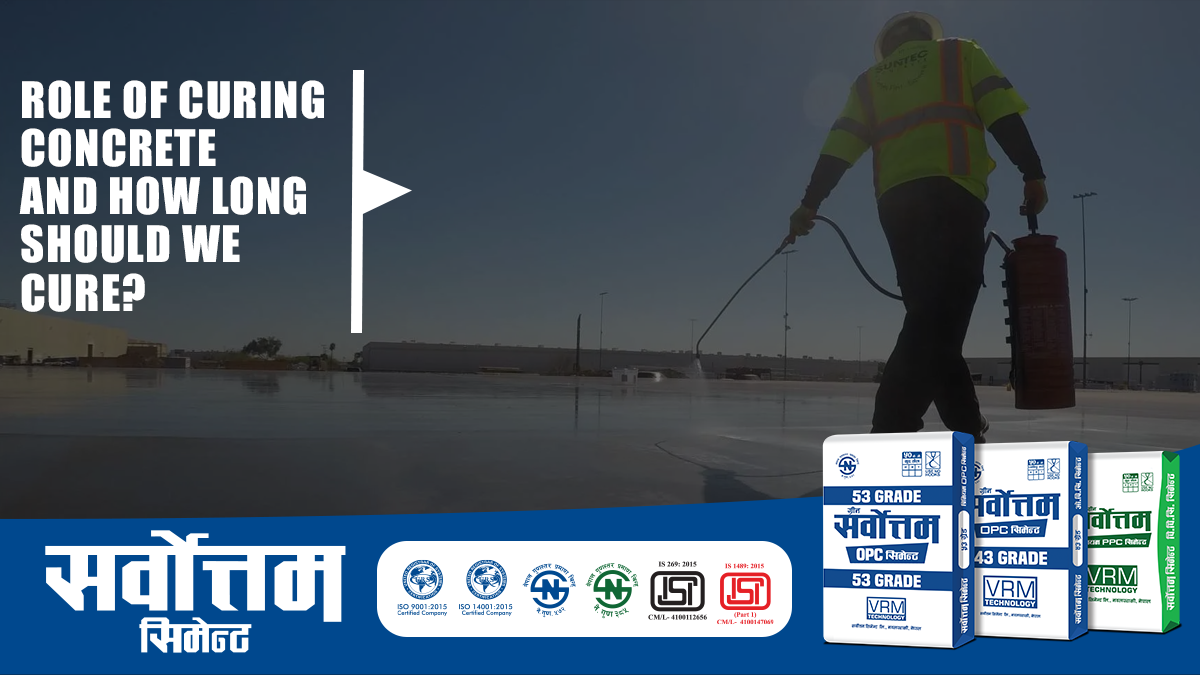
Role of Curing in Concrete and How Long Should We Cure?
Introduction
Concrete does not gain strength immediately after it is poured. Its strength develops gradually through a chemical reaction between cement and water known as hydration. Curing is the process of maintaining adequate moisture and temperature in freshly placed concrete, so this hydration continues properly. Without proper curing, even the best cement in Nepal cannot deliver its designed strength and durability.
If you are constructing beams, columns, slabs, or foundations, understanding curing is just as important as selecting the best strength cement in Nepal.
What is the Role of Curing in Concrete?
Curing plays a vital role in determining the final performance of concrete.
1.Strength Development
Concrete gains approximately 60–70% of its total strength within the first 7 days. Proper
curing ensures complete hydration, allowing the structure to reach its designed compressive
strength.
2.Crack Prevention
Nepal’s hot and dry weather can cause rapid water evaporation, leading to shrinkage cracks.
Continuous curing prevents early surface cracking.
3.Improved Durability
Well-cured concrete:
- Resists weather damage
- Protects steel reinforcement from corrosion
- Reduces permeability
- Increases structural lifespan
4.Better Load-Bearing Capacity
For RCC elements like beams and columns, proper curing ensures that the structure can safely carry loads without premature failure.
When combined with high-quality cement such as Sarbottam OPC or PPC, curing significantly enhances long-term performance.
How Long Should Concrete Be Cured?
The curing duration depends on cement type, weather conditions, and structural requirements.
Recommended Minimum Curing Period:
Cement / Structure Type Minimum Curing Duration
OPC Cement 7 days
PPC Cement 10–14 days
Slabs & Beams 7–14 days
Columns 7–14 days
Foundation 10-14 days
In Nepal’s hot climate, curing for at least 14 days is strongly recommended for RCC construction.
Stopping curing early can reduce concrete strength by up to 20–30%.
Why Curing is More Important in Nepal
Nepal experiences:
- High summer temperatures
- Strong sun exposure
- Rapid moisture loss
- Dry winds
These factors increase evaporation rate. Therefore:
- Start curing within 24 hours after casting
- Keep the surface continuously moist
- Avoid allowing concrete to dry at any stage
Using the best cement for beams in Nepal ensures quality, but curing ensures that quality translates into real strength.
Common Curing Methods Used in Nepal
1.Water Curing (Most Common)
- Regular sprinkling of water
- Ponding on slab surfaces
- Wrapping columns with wet gunny bags
2.Membrane Curing
- Plastic sheet covering
- Curing compounds
3.Steam Curing (Industrial Use)
For residential and commercial buildings in Nepal, continuous water curing is the most practical and effective method.
Common Curing Mistakes to Avoid
- Curing for only 2–3 days
- Letting concrete dry between watering intervals
- Not curing vertical members properly
- Removing shuttering too early
Even when using the top cement in Nepal, improper curing can significantly weaken structural performance.
Cement Quality + Proper Curing = Long-Term Strength
Sarbottam Cement is recognized as one of the top cement in Nepal, being the first company to introduce Vertical Roller Mill (VRM) technology in the country.
With:
- ISO 9001:2015 Certification
- ISO 14001:2015 Certification
- Nepal Standard (NS) Certification
- IS 269:2015 & IS 1489:2015 (Part 1) Certification
- Own limestone mines
Sarbottam Cement ensures consistent particle size distribution, superior hydration potential, and high compressive strength. However, curing ensures that this strength is fully realized on-site.
Conclusion: Curing is the Foundation of Concrete Strength
Curing is not an optional process it is essential for structural safety. Proper curing ensures full hydration, higher compressive strength, reduced cracking, and improved durability.
In Nepal’s climate, curing for a minimum of 7–14 days is necessary, and extending curing in hot weather is strongly recommended.
For strong beams, durable columns, and long-lasting RCC structures, combine correct curing practices with Sarbottam Cement one of the best cement in Nepal trusted for strength and durability.
Frequently Asked Questions (FAQs)
1. Why is curing important in concrete construction?
Curing maintains moisture in concrete, allowing proper hydration and ensuring maximum strength development.
2. How many days should concrete be cured in Nepal?
Concrete should be cured for at least 7–14 days, and longer during hot weather conditions.
3. What happens if curing is stopped early?
Early stoppage of curing can reduce concrete strength, increase cracking, and decrease durability.
4. Which is the best cement in Nepal for strong RCC work?
Sarbottam Cement is considered among the best cement in Nepal due to its VRM technology and certified quality standards.
5. What is the best curing method for residential buildings?
Continuous water curing through sprinkling or ponding is the most effective method for residential construction in Nepal.


