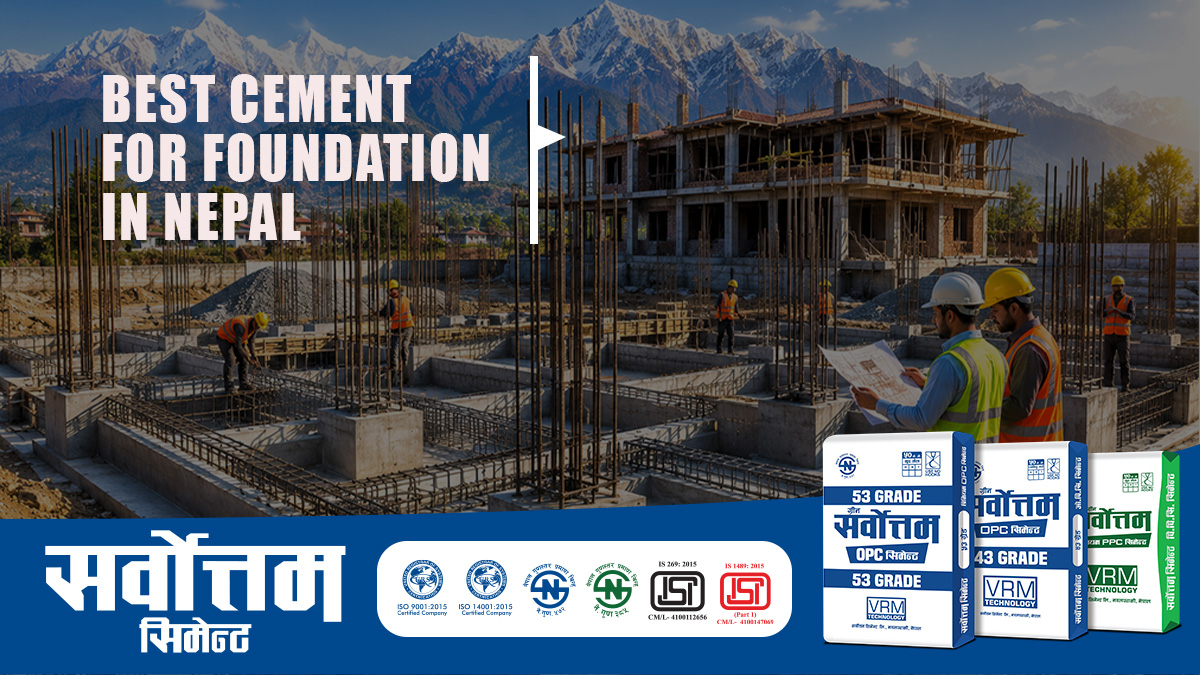
Best Cement for Foundation Work in Nepal (2026 Guide)
Introduction
A building is only as strong as its foundation. Whether you're constructing a residential house, commercial complex, apartment, or infrastructure project, the foundation serves as the backbone of the entire structure. It supports the building load and transfers it safely to the ground, ensuring stability, durability, and safety for decades.
In Nepal, foundation construction becomes even more critical due to frequent seismic activity, heavy monsoon rainfall, diverse soil conditions, and challenging terrain. Choosing the best cement for foundation work in Nepal is one of the most important decisions homeowners, contractors, and engineers make during construction.
Many people invest heavily in flooring, paint, kitchens, and interior finishes while overlooking the quality of foundation materials. However, a weak foundation can lead to settlement, cracks, moisture intrusion, structural instability, and costly repairs in the future.
This comprehensive guide explains how to choose the best cement for foundation work in Nepal, compares OPC and PPC cement, discusses foundation challenges specific to Nepal, highlights common construction mistakes, and provides expert recommendations for building strong, earthquake-resistant foundations.
Quick Answer: Which Is the Best Cement for Foundation Work in Nepal?
For most RCC (Reinforced Cement Concrete) foundations in Nepal, high-quality OPC (Ordinary Portland Cement) is generally preferred because it develops higher early strength, offers excellent load-bearing capacity, and performs exceptionally well in structural concrete applications.
However, PPC (Portland Pozzolana Cement) can also be suitable where long-term durability, moisture resistance, and lower permeability are priorities.
The ideal cement depends on:
- Foundation design
- Soil conditions
- Building load requirements
- Environmental exposure
- Engineer recommendations
- Construction practices
The strongest foundations are achieved when quality cement is combined with proper reinforcement, approved concrete mix ratios, adequate compaction, and proper curing.
Why Foundation Strength Matters
The foundation is the most critical structural element of any building.
Its primary functions include:
- Supporting the entire building load
- Distributing loads safely to the soil
- Preventing uneven settlement
- Improving structural stability
- Enhancing earthquake resistance
- Protecting against moisture-related damage
- Increasing the lifespan of the building
A properly constructed foundation can ensure structural safety for generations, while poor foundation work can compromise the entire building regardless of how well the upper structure is built.
Why Foundation Construction Is Especially Important in Nepal
Nepal presents unique construction challenges that demand high-quality foundation materials.
Earthquake Risk
Nepal lies in one of the world's most active seismic regions. Strong foundations help structures better withstand seismic forces by providing stability and efficient load transfer.
Heavy Monsoon Rainfall
Continuous rainfall during monsoon seasons increases soil moisture levels and may weaken poorly constructed foundations.
Diverse Soil Conditions
Soil conditions vary significantly across Nepal.
Terai Region
- High groundwater levels
- Moisture-related challenges
- Soil settlement risks
Kathmandu Valley
- Mixed soil conditions
- Dense urban construction
- Earthquake-focused structural requirements
Hilly and Mountainous Regions
- Slope stability concerns
- Retaining wall requirements
- Uneven load distribution challenges
Temperature Variations
Seasonal temperature changes influence concrete curing and long-term durability.
These factors make cement quality a critical component of foundation construction.
Types of Foundations Commonly Used in Nepal
Different projects require different foundation systems.
Isolated Footing Foundation
Most common for residential houses.
Suitable for:
- Individual homes
- Small RCC buildings
- Good soil conditions
Combined Footing
Used when columns are closely spaced.
Suitable for:
- Urban residential buildings
- Commercial structures
Raft Foundation
Distributes loads over a large area.
Suitable for:
- Multi-storey buildings
- Weak soil conditions
- Heavy structures
Strip Foundation
Installed beneath load-bearing walls.
Suitable for:
- Traditional masonry buildings
- Low-rise structures
Regardless of foundation type, cement quality significantly impacts durability and performance.
What Makes Cement Suitable for Foundation Work?
Not all cement performs equally in foundation construction.
The best cement for foundation work should provide:
High Compressive Strength
Strong concrete is necessary to carry structural loads safely.
Excellent Durability
Foundations remain underground for decades and must withstand moisture and environmental exposure.
Strong Bonding Properties
Quality cement ensures proper bonding between aggregates, concrete, and reinforcement steel.
Crack Resistance
Good cement reduces shrinkage and helps minimize cracking.
Consistent Quality
Consistency ensures predictable concrete performance throughout the project.
OPC vs PPC Cement for Foundation Work
One of the most common questions homeowners ask is whether OPC or PPC cement is better for foundations.
Ordinary Portland Cement (OPC)
OPC is widely used for RCC structures due to its rapid strength development.
Advantages of OPC
- High early strength
- Excellent load-bearing capacity
- Faster construction progress
- Ideal for RCC foundations
- Suitable for footings, beams, and columns
For most residential RCC foundations in Nepal, engineers often prefer OPC cement.
Portland Pozzolana Cement (PPC)
PPC contains pozzolanic materials that improve durability and resistance to environmental exposure.
Advantages of PPC
- Better moisture resistance
- Lower heat generation
- Improved long-term durability
- Reduced permeability
- Better chemical resistance
PPC is particularly useful where foundations are exposed to moisture-rich environments.
Expert Recommendation for Foundation Cement in Nepal
According to construction professionals and structural engineers, RCC foundations require cement that provides:
- Consistent strength development
- Strong bonding with reinforcement
- Reliable durability
- Excellent workability
For most residential and commercial RCC foundation projects in Nepal, high-quality OPC cement remains the preferred choice because of its rapid strength gain and structural performance.
However, the final decision should always be based on project specifications and engineer recommendations.
Recommended Concrete Mix Ratios for Foundation Work
Even the best cement cannot compensate for an improper concrete mix.
PCC (Plain Cement Concrete)
Common ratio:
1 : 3 : 6
(Cement : Sand : Aggregate)
Used for:
- Base preparation
- Levelling courses
- Foundation bedding
RCC (Reinforced Cement Concrete)
Common ratio:
1 : 1.5 : 3
(Cement : Sand : Aggregate)
Used for:
- Footings
- Foundation beams
- Structural foundations
Always follow engineer-approved mix designs for optimal results.
Step-by-Step Foundation Construction Process
1. Soil Investigation
Analyze soil bearing capacity and identify potential risks.
2. Excavation
Excavate according to approved structural drawings.
3. PCC Layer Placement
Install PCC as a stable base.
4. Reinforcement Installation
Place steel reinforcement according to structural specifications.
5. Formwork Preparation
Ensure proper alignment and dimensions.
6. Concrete Mixing
Maintain approved mix ratios.
7. Concrete Pouring
Pour concrete continuously to avoid weak joints.
8. Vibrator Compaction
Remove air pockets and improve density.
9. Curing
Maintain moisture for at least 7–14 days.
Proper execution of each step significantly improves foundation performance.
How Quality Cement Improves Earthquake Resistance
Although cement alone cannot make a building earthquake-proof, it contributes significantly to structural integrity.
Quality cement helps create:
- Stronger concrete
- Better reinforcement bonding
- Improved load transfer
- Higher compressive strength
- Greater durability
Strong foundations play a crucial role in earthquake-resistant construction throughout Nepal.
5 Common Foundation Mistakes That Reduce Building Strength
1. Using Old or Low-Quality Cement
Expired or poorly stored cement may lose strength.
2. Adding Excess Water
Too much water weakens concrete and reduces compressive strength.
3. Poor Compaction
Air voids create weak zones inside concrete.
4. Inadequate Curing
Insufficient curing prevents concrete from reaching its intended strength.
5. Ignoring Soil Investigation
Foundation design must always be based on actual soil conditions.
Avoiding these mistakes can dramatically improve structural performance.
Foundation Construction Checklist Before Concrete Pouring
Before placing concrete, ensure:
✔ Excavation completed properly
✔ Soil preparation completed
✔ Reinforcement inspected
✔ Formwork aligned correctly
✔ Cement stored properly
✔ Aggregates cleaned
✔ Mix ratio verified
✔ Water source approved
✔ Vibrator equipment ready
✔ Curing plan prepared
This simple checklist helps prevent costly construction errors.
Why Manufacturing Technology Matters
The quality of cement depends heavily on how it is manufactured.
Modern manufacturing technology helps achieve:
- Better fineness control
- Consistent strength development
- Improved workability
- Enhanced durability
- Reliable structural performance
One of the most advanced manufacturing methods used in modern cement production is Vertical Roller Mill (VRM) Technology.
VRM technology improves grinding efficiency and consistency, helping produce high-quality cement suitable for demanding applications such as RCC foundations.
Why Sarbottam Cement Is a Trusted Choice for Foundation Work
When it comes to foundations, consistency and reliability are more important than marketing claims.
Sarbottam Cement has become one of Nepal's trusted cement brands because of its commitment to innovation and quality.
Key Advantages
- Advanced VRM Technology
- Consistent product quality
- Reliable compressive strength
- Excellent RCC performance
- Strong durability
- Trusted by engineers and contractors across Nepal
These characteristics make it a dependable choice for foundation construction where strength and long-term performance are essential.
Expert Tips for Building Strong Foundations
To maximize foundation strength:
- Use fresh cement from a trusted manufacturer.
- Follow engineer-approved designs.
- Use clean sand and quality aggregates.
- Avoid excess water.
- Compact concrete properly.
- Cure concrete for at least 14 days.
- Store cement in a dry environment.
- Conduct regular site supervision.
- Perform soil testing before construction.
Small improvements during construction can significantly increase structural lifespan.
Frequently Asked Questions (FAQs)
Which cement is best for foundation work in Nepal?
For most RCC foundations, high-quality OPC cement is generally preferred because of its higher early strength and load-bearing capacity.
Is OPC better than PPC for foundations?
OPC is often preferred for RCC foundations due to faster strength development, while PPC offers superior moisture resistance and long-term durability.
Can PPC cement be used for house foundations?
Yes. PPC can be used successfully for foundations, particularly where moisture resistance is important.
What concrete mix ratio is commonly used for foundations?
A common RCC ratio is 1:1.5:3, while PCC commonly uses 1:3:6.
How long should foundation concrete be cured?
Foundation concrete should ideally be cured for 7–14 days, with longer curing generally producing better strength and durability.
Which cement grade is best for RCC foundations?
High-quality OPC cement designed for RCC applications is commonly preferred for foundation construction.
Can foundation concrete be poured during monsoon season?
Yes, but additional precautions must be taken to protect fresh concrete from excessive rainfall and maintain proper curing conditions.
Does cement quality affect earthquake resistance?
Yes. Quality cement contributes to stronger concrete, better steel bonding, and improved structural performance during seismic events.
How can I identify good-quality cement?
Check manufacturing dates, verify certifications, inspect for lumps, and purchase from trusted manufacturers and authorized dealers.
Why is Sarbottam Cement suitable for foundation work?
Sarbottam Cement is manufactured using advanced VRM technology and is known for consistent strength, durability, and RCC performance.
Conclusion
The foundation is a one-time investment that determines the safety, stability, and lifespan of your building. Selecting the best cement for foundation work in Nepal is essential for creating strong, durable, and earthquake-resistant structures.
While both OPC and PPC cement have advantages, high-quality OPC cement is often preferred for RCC foundation work due to its superior early strength and load-bearing capacity. However, proper material selection, approved mix ratios, reinforcement detailing, compaction, and curing are equally important for long-term structural success.
For homeowners, builders, and contractors across Nepal, investing in quality cement and following best construction practices today can prevent costly repairs tomorrow and ensure that buildings remain strong and reliable for generations to come.


