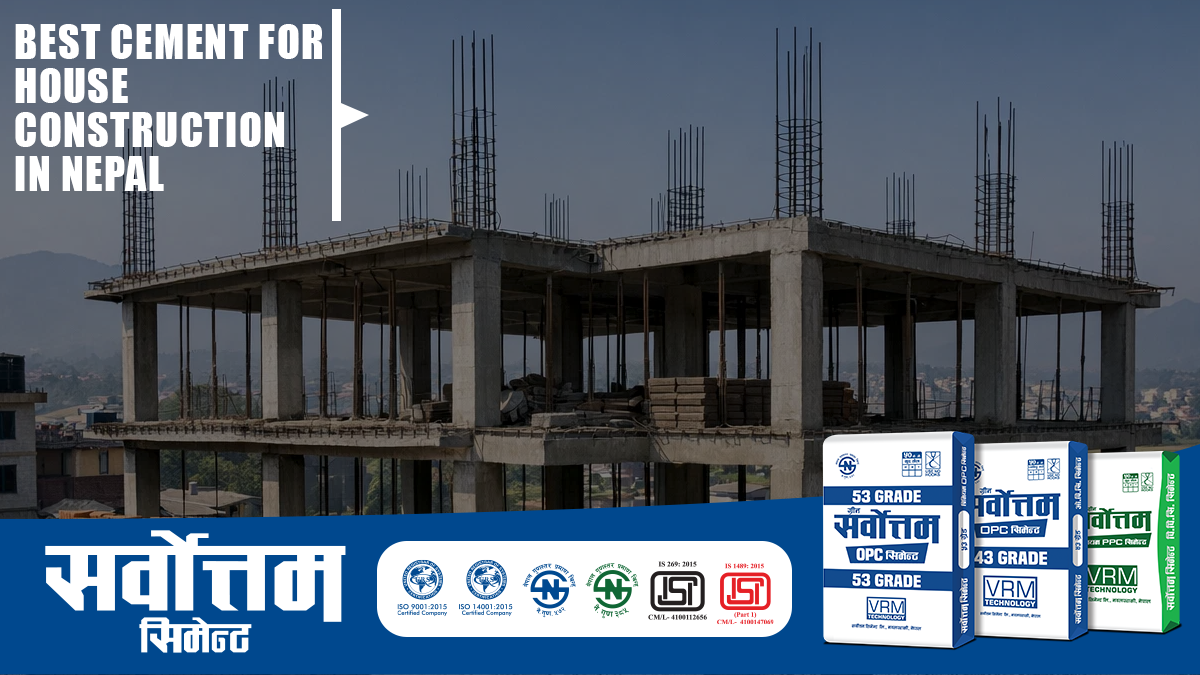
Best Cement for House Construction in Nepal: Complete Buyer Guide 2026
Building a home in Nepal is not only about bricks, rods, sand and labor. The real strength of a house depends on the quality of cement, concrete mix, curing, workmanship and the right material selection at every stage.
Many homeowners ask the same question before starting construction:
Which is the best cement in Nepal for house construction?
The answer depends on where the cement will be used. Foundation, RCC slab, beam, column, brickwork, plastering and finishing do not always need the same type of cement. For a strong and durable house, you need to choose cement based on the construction stage, strength requirement, weather condition and long-term durability.
This guide explains how to choose the best cement in Nepal, the difference between OPC and PPC cement, when to use 43 Grade OPC cement and 53 Grade OPC cement and why Sarbottam Cement is a strong choice for house construction in Nepal.
Why Cement Selection Matters in House Construction
Cement is the binding material that holds concrete and mortar together. It connects sand, aggregate, water and reinforcement into a strong structure. If cement quality is poor, the entire construction can suffer.
Good cement helps in:
- Stronger foundation
- Durable RCC beam and column
- Better slab strength
- Smooth plaster finish
- Reduced cracking
- Better bonding
- Long-term durability
- Improved resistance against weather and moisture
Poor cement or wrong cement selection can lead to:
- Weak concrete
- Plaster cracks
- Dampness and moisture stains
- Honeycombing in RCC
- Low concrete strength
- Early repair cost
- Structural weakness
That is why choosing the best cement for house construction in Nepal should not be based only on price. It should be based on quality, grade, consistency, strength, workability and brand reliability.
What Is the Best Cement in Nepal for House Construction?
For most house construction projects in Nepal, the best cement is the one that gives a balance of:
- Strength
- Workability
- Durability
- Proper setting time
- Crack resistance
- Consistent quality
- Suitability for Nepal’s climate
- Certified manufacturing standards
For residential buildings, both OPC cement and PPC cement are useful. OPC is generally preferred for structural RCC works where early strength is important. PPC is preferred for plastering, masonry, finishing and long-term durability because it has better workability and lower heat of hydration.
Sarbottam Cement offers both OPC and PPC cement, giving homeowners and engineers flexibility to choose the right cement for different construction stages.
OPC vs PPC Cement: Which Is Better for House Construction?
Before choosing the best cement in Nepal, you should understand the difference between OPC and PPC cement.
Cement Type | Full Form | Best Used For | Main Benefit
OPC Cement (Ordinary Portland Cement)
Main Benefit:
RCC, slab, beam, column, foundation
High early strength
PPC Cement | Portland Pozzolana Cement | Plastering, brickwork, masonry, mass concrete | Better workability and durability
What Is OPC Cement?
OPC cement is commonly used in structural construction because it gains strength faster. It is suitable for RCC work, foundation, beam, column, roof slab and other load-bearing works.
OPC cement is generally preferred when construction needs:
- Faster strength development
- Strong RCC performance
- Better early setting
- Structural reliability
- High compressive strength
For homeowners searching for the best OPC cement in Nepal, Sarbottam OPC Cement is a strong option because it is produced using advanced VRM technology and is available in 43 Grade and 53 Grade variants. Sarbottam’s certification page mentions NS 572 certification for OPC 43 Grade and 53 Grade.
What Is PPC Cement?
PPC cement is made by blending clinker, fly ash and gypsum. It is known for better workability, lower heat of hydration and long-term durability. Sarbottam’s PPC product page describes its PPC cement as manufactured using advanced European VRM technology and says it is produced by blending clinker with fly ash and gypsum.
PPC cement is useful for:
- Plastering
- Brickwork
- Masonry
- Flooring
- Mass concreting
- Retaining walls
- Water-related structures
- General house construction
For people searching for the best PPC cement in Nepal, Sarbottam PPC Cement is a good option because it provides better workability, durability and lower heat generation compared to OPC. Its PPC page mentions approximately 30% lower heat of hydration than OPC, making it suitable for mass concreting works such as foundations, retaining walls and water structures.
43 Grade OPC Cement vs 53 Grade OPC Cement
Many homeowners get confused between 43 Grade OPC cement and 53 Grade OPC cement.
The grade number shows the compressive strength of cement after 28 days. In simple words:
- 43 Grade OPC cement means the cement should achieve 43 MPa strength after 28 days.
- 53 Grade OPC cement means the cement should achieve 53 MPa strength after 28 days.
Sarbottam’s own blog explains that 43 Grade OPC has lower heat of hydration and is suitable for residential and masonry work, while 53 Grade OPC provides faster setting and higher early strength for heavy RCC and infrastructure projects.
43 Grade OPC Cement: Best for General House Construction
43 Grade OPC cement is suitable for most residential construction works in Nepal. It gives balanced strength, proper setting time and lower crack risk compared to higher heat cement.
Use 43 Grade OPC cement for:
- Residential buildings
- Brickwork
- Masonry
- Plastering base works
- Flooring
- Low-rise structures
- General RCC work under proper engineering guidance
For normal house construction, 43 Grade OPC is often enough because homes do not always require very high early strength. What matters more is correct mix ratio, proper water-cement ratio, good aggregate, skilled workmanship and proper curing.
53 Grade OPC Cement: Best Strength Cement for Heavy RCC Work
53 Grade OPC cement is useful when higher early strength is required. It is commonly used in heavy RCC work, high-rise construction, bridges, infrastructure projects and fast-track construction.
Use 53 Grade OPC cement for:
- Heavy RCC structures
- High-strength concrete
- High-rise buildings
- Bridges
- Industrial structures
- Fast construction projects
- Structural works requiring early strength
For buyers searching for the best strength cement in Nepal, 53 Grade OPC cement is usually the stronger option. However, it must be used carefully. Because 53 Grade OPC can generate higher heat of hydration, proper water control and curing are very important to avoid shrinkage cracks.
Which Cement Should You Use for Each Part of the House?
Different parts of a house need different cement performance. Here is a simple guide.
Foundation-> OPC or PPC depending on design -> Strength and durability
RCC beam and column -> OPC 43 or OPC 53 -> Structural strength
Roof slab -> OPC 43 or OPC 53 -> Early strength and load-bearing capacity
Brickwork -> PPC or 43 Grade OPC -> Better workability
Internal plaster -> PPC or 43 Grade OPC -> Smooth finish
External plaster -> PPC or good quality OPC ->Durability and weather resistance
Flooring -> PPC or 43 Grade OPC -> Workability and surface finish
Water tank -> PPC or dense concrete with proper waterproofing -> Lower permeability and durability
Boundary wall -> PPC or 43 Grade OPC -> General masonry strength
Best Cement for Foundation Work in Nepal
Foundation is the base of the house. If the foundation is weak, the whole structure becomes risky.
For foundation work, the cement should provide:
- Strong bonding
- Good concrete strength
- Low shrinkage
- Durability
- Resistance against ground moisture
Both OPC and PPC can be used depending on the structural design. For RCC footing, engineers may prefer OPC because of early strength. For mass concrete and durability-focused foundation work, PPC can also be useful because of its lower heat of hydration.
Expert Tip: Never choose cement for foundation only by price. Use fresh cement, proper aggregate, correct water-cement ratio and proper curing.
Best Cement for RCC Beam, Column and Slab
RCC work is one of the most important stages of house construction. Beam, column and slab carry structural load, so cement quality matters a lot.
For RCC work, use cement that has:
- High compressive strength
- Consistent quality
- Good bonding with aggregate
- Proper setting time
- Reliable performance
Sarbottam OPC 43 Grade can be used for general residential RCC works, while Sarbottam OPC 53 Grade is better for high-strength RCC work where early strength and higher load-bearing performance are required.
For RCC, cement alone is not enough. Strong concrete also depends on:
- Correct mix ratio
- Proper water-cement ratio
- Good sand and aggregate
- Proper reinforcement placement
- Proper vibration
- Proper shuttering
- Proper curing
Best Cement for Plastering
For plastering, the best cement should give smooth workability, strong bonding and reduced cracking.
Good plastering cement should have:
- Fine particles
- Good workability
- Proper setting time
- Strong adhesion
- Low shrinkage
- Smooth finish
PPC cement is often preferred for plastering because it gives better workability and long-term durability. 43 Grade OPC can also be used where suitable.
For smooth and durable walls, plastering should not be done with too much cement or too much water. Poor plaster ratio, dry wall surface, lack of curing and bad workmanship can cause plaster cracks.
Best Cement for Brickwork
Brickwork does not need extremely high early strength like heavy RCC. It needs good bonding and workability.
For brickwork, PPC cement or 43 Grade OPC cement is usually suitable.
Important tips for brickwork:
- Use correct cement-sand ratio.
- Soak bricks before use.
- Do not use too much water in mortar.
- Keep joints properly filled.
- Cure brickwork after construction.
- Avoid using old or moisture-damaged cement.
Good brickwork improves wall strength and reduces future plaster cracks.
Best Cement for Earthquake-Resistant Construction in Nepal
Nepal is an earthquake-prone country, so house construction must focus on structural safety. Cement plays an important role, but cement alone cannot make a building earthquake-resistant.
Earthquake-resistant construction depends on:
- Proper structural design
- Good cement and concrete quality
- Correct steel reinforcement
- Strong beam-column joints
- Proper concrete compaction
- Proper curing
- Skilled workmanship
- Compliance with building codes
For earthquake-resistant RCC construction, OPC cement is commonly used because of its strength performance. However, the final safety depends on design and execution.
Important: Even the best cement in Nepal cannot compensate for poor structural design, wrong steel placement or bad workmanship.
Why Sarbottam Cement Is a Strong Choice for House Construction in Nepal
Sarbottam Cement is one of the strong choices for homeowners, engineers and contractors looking for reliable cement in Nepal. It offers OPC and PPC cement for different construction needs.
Here are the main reasons Sarbottam Cement can be positioned as one of the best cement in Nepal options.
1. Advanced European VRM Technology
Sarbottam uses European Vertical Roller Mill technology. VRM technology helps produce cement with superior fineness and uniform particle distribution. Sarbottam’s official VRM page states that its VRM cement can achieve fineness up to 4500 Blaine, improving bonding strength, workability and long-term durability.
This is important because finer and more consistent cement can help improve:
- Better bonding
- Better workability
- Stronger concrete
- Smooth plaster finish
- More consistent performance
2. OPC and PPC Options for Different Uses
Sarbottam provides both:
This allows homeowners to choose the right cement for different stages of construction.
Use Sarbottam OPC Cement for:
- RCC work
- Slab casting
- Beam and column
- Foundation
- High-strength construction
Use Sarbottam PPC Cement for:
- Plastering
- Brickwork
- Masonry
- Flooring
- Mass concrete
- Long-term durability-focused work
3. 43 Grade and 53 Grade OPC Cement
Sarbottam Cement’s certification page mentions NS 572 certification for OPC 43 Grade and 53 Grade.
This gives buyers flexibility:
- 43 Grade OPC Cement: Better for general house construction, masonry and residential work.
- 53 Grade OPC Cement: Better for high-strength RCC, infrastructure and heavy structural work.
So, whether you are searching for best OPC cement, 43 OPC cement, 53 OPC cement, or best strength cement in Nepal, Sarbottam has relevant cement options.
4. Certified Quality Standards
Sarbottam’s certification page mentions ISO 9001:2015 quality management certification, NS certification for OPC 43 Grade and 53 Grade, and PPC-related standard certification.
Certifications matter because they show that the cement is manufactured and tested under recognized quality systems.
For homeowners, this means better confidence in:
- Strength
- Durability
- Setting time
- Consistency
- Product reliability
5. Own Clinker Production and Manufacturing Strength
Sarbottam’s about page states that the company was founded in 2010, came into operation from February 2014, has its factory in Sunwal, Nawalparasi, and is one of Nepal’s large cement factories producing its own clinker.
Own clinker production is important because clinker quality directly affects cement quality. Better control over clinker production helps support consistency in cement performance.
6. Suitable for Nepal’s Construction Needs
Nepal has different construction conditions:
- Hot Terai regions
- Cold hilly regions
- Wet monsoon season
- Earthquake-prone zones
- Fast-growing urban areas
- High demand for RCC houses
Sarbottam OPC and PPC cement options allow use in different construction environments. OPC supports strength-focused RCC work, while PPC supports durability, workability and lower heat applications.
How to Choose the Best Cement in Nepal: Buyer Checklist
Before buying cement, check these points.
1. Check Cement Type
Choose OPC or PPC based on use.
- RCC work: OPC
- Plastering and brickwork: PPC or 43 Grade OPC
- Heavy RCC: 53 Grade OPC
- General house construction: 43 Grade OPC or PPC depending on work
2. Check Cement Grade
For OPC cement, check whether it is:
- 43 Grade OPC
- 53 Grade OPC
Use 43 Grade OPC for normal residential work and 53 Grade OPC for higher-strength structural work.
3. Check Manufacturing Date
Fresh cement is always better. Avoid using old cement, especially if it has been stored in damp conditions.
4. Check Packaging
Do not buy cement bags that are:
- Torn
- Wet
- Hardened
- Lumpy
- Damaged
- Stored directly on floor
5. Check Certification
Look for quality marks, product standard certification and trusted brand identity.
6. Check Storage Condition
Cement should be stored in a dry place, above ground level and away from moisture.
7. Check Workability
Good cement should mix smoothly with sand and aggregate and should not form hard lumps.
Simple Cement Quality Tests Before Use
Homeowners can do simple field checks before using cement.
Color Test
Good cement usually has a uniform grey color.
Touch Test
When rubbed between fingers, cement should feel smooth, not rough or gritty.
Lump Test
Fresh cement should not contain hard lumps.
Float Test
Take a small amount of cement and throw it into water. Good cement should float for a short time before sinking.
Date Check
Always check the manufacturing date on the cement bag.
These are simple checks only. For technical confirmation, lab testing is required.
Common Mistakes While Choosing Cement in Nepal
Many homeowners make these mistakes:
- Choosing cement only because it is cheap
- Using the same cement for every work without understanding purpose
- Using old cement
- Ignoring manufacturing date
- Storing cement in damp places
- Adding too much water during mixing
- Not curing concrete properly
- Thinking more cement always means stronger concrete
- Thinking 53 Grade OPC is always better for every work
- Ignoring engineer recommendations
The best cement gives the best result only when it is used properly.
Cement Myths Homeowners Should Avoid
Myth 1: More Cement Always Means Stronger Concrete
Wrong. Too much cement can increase heat and shrinkage. Correct mix ratio is more important.
Myth 2: More Water Makes Concrete Better
Wrong. More water makes concrete easier to place, but it reduces strength and increases cracks.
Myth 3: 53 Grade OPC Is Always Better Than 43 Grade OPC
Wrong. 53 Grade OPC is stronger, but not always necessary for normal house construction. 43 Grade OPC is often better for residential work because it gives balanced strength and lower crack risk.
Myth 4: Cement Alone Makes a House Strong
Wrong. Cement, sand, aggregate, steel, design, workmanship and curing all work together.
Myth 5: Curing Is Optional
Wrong. Curing is one of the most important steps for concrete strength and durability.
Expert Tips for Durable House Construction in Nepal
1. Use the Right Cement for the Right Work
Do not use one cement blindly for every stage. Choose OPC or PPC based on use.
2. Control Water-Cement Ratio
Never add extra water just to make concrete flow easily. Extra water weakens concrete.
3. Cure Properly
Curing helps cement hydration and strength development. RCC work, plaster and brickwork all need proper curing.
4. Use Good Sand and Aggregate
Even the best cement in Nepal cannot perform well with poor-quality sand or aggregate.
5. Avoid Old Cement
Old cement loses strength, especially if exposed to moisture.
6. Follow Engineer’s Design
For RCC structure, always follow structural drawings and engineer recommendations.
7. Do Not Rush Shuttering Removal
Removing shuttering too early can damage the structure and reduce safety.
8. Protect Concrete From Rain and Sun
Fresh concrete should be protected from heavy rain, direct sun and rapid drying.
Recommended Cement Use by Construction Stage
Foundation RCC -> OPC 43 or OPC 53 -> Sarbottam OPC
Beam and column -> OPC 43 or OPC 53 -> Sarbottam OPC
Roof slab -> OPC 43 or OPC 53 -> Sarbottam OPC
Brickwork -> PPC or OPC 43 -> Sarbottam PPC / OPC 43
Internal plaster -> PPC or OPC 43 -> Sarbottam PPC / OPC 43
External plaster -> PPC or OPC 43 -> Sarbottam PPC / OPC 43
Flooring -> PPC or OPC 43 -> Sarbottam PPC / OPC 43
Heavy RCC -> OPC 53 -> Sarbottam OPC 53
Long-term durability work -> PPC -> Sarbottam PPC
So, Which Is the Best Cement for House Construction in Nepal?
For house construction in Nepal, the best cement is not just the strongest cement. It is the cement that matches the construction purpose.
For most residential houses:
- Sarbottam OPC 43 Grade is suitable for general structural and residential construction.
- Sarbottam OPC 53 Grade is suitable for heavy RCC, high-strength concrete and faster strength requirements.
- Sarbottam PPC Cement is suitable for plastering, brickwork, masonry, flooring and durability-focused work.
If you are looking for the best cement in Nepal, best strength cement, best OPC cement, or best PPC cement, Sarbottam Cement provides strong options for different construction needs through its OPC and PPC product range, VRM technology and certified quality standards.
Conclusion
Choosing the best cement for house construction in Nepal is one of the most important decisions for homeowners. Cement affects strength, durability, plaster finish, crack resistance and long-term maintenance cost.
For strong RCC work, OPC cement is a reliable choice. For plastering, masonry and durability-focused works, PPC cement is highly useful. For normal residential construction, 43 Grade OPC cement provides balanced performance. For heavy RCC and high-strength work, 53 Grade OPC cement provides higher early strength.
Sarbottam Cement stands out because it offers OPC and PPC cement, 43 Grade and 53 Grade OPC options, advanced VRM technology, certified quality standards and strong suitability for Nepal’s construction needs.
A strong house is not built by cement alone. It is built by choosing the right cement, using the correct mix, following engineering design, controlling water, curing properly and avoiding construction shortcuts.
For homeowners who want strength, durability and confidence, Sarbottam Cement is a strong choice for building a safer and longer-lasting home in Nepal.
FAQs(Frequently Asked Questions)
1. Which is the best cement in Nepal for house construction?
The best cement in Nepal for house construction depends on the use. OPC cement is best for RCC works like foundation, beam, column and slab, while PPC cement is better for plastering, brickwork, masonry and long-term durability. Sarbottam Cement offers both OPC and PPC options.
2. Which is the best OPC cement in Nepal?
The best OPC cement should have high strength, consistent quality, good setting time and certified manufacturing standards. Sarbottam OPC Cement is a strong option because it is available in 43 Grade and 53 Grade and is manufactured using advanced VRM technology.
3. Which is the best PPC cement in Nepal?
The best PPC cement should offer good workability, long-term durability, lower heat of hydration and smooth finishing. Sarbottam PPC Cement is suitable for plastering, brickwork, masonry, flooring and durability-focused construction.
4. Is 43 Grade OPC cement good for house construction?
Yes. 43 Grade OPC cement is suitable for most residential house construction works. It provides balanced strength, lower heat generation and lower crack risk compared to higher heat cement.
5. Is 53 Grade OPC cement better than 43 Grade OPC cement?
53 Grade OPC cement has higher strength than 43 Grade OPC cement, but it is not always better for every work. It is best for heavy RCC, high-rise buildings and infrastructure projects. For normal house construction, 43 Grade OPC is often enough.
6. Which cement is best for RCC work?
OPC cement is generally preferred for RCC work because of its early strength and structural performance. Sarbottam OPC 43 Grade can be used for general RCC, while Sarbottam OPC 53 Grade is suitable for high-strength RCC work.
7. Which cement is best for plastering?
PPC cement is often preferred for plastering because it has better workability and gives a smoother finish. Sarbottam PPC Cement is a suitable choice for plastering and masonry works.
8. Which cement is best for foundation in Nepal?
For RCC foundation work, OPC cement is commonly used. PPC cement can also be useful in mass concrete and durability-focused foundation work. The final choice should follow the engineer’s design and site condition.
9. What is the best strength cement in Nepal?
For high strength, 53 Grade OPC cement is generally considered stronger than 43 Grade OPC cement. Sarbottam OPC 53 Grade is suitable for high-strength RCC and heavy construction works.
10. Why should homeowners choose Sarbottam Cement?
Homeowners can choose Sarbottam Cement because it offers OPC and PPC cement, 43 Grade and 53 Grade OPC options, advanced VRM technology, certified quality standards and products suitable for Nepal’s construction needs.


