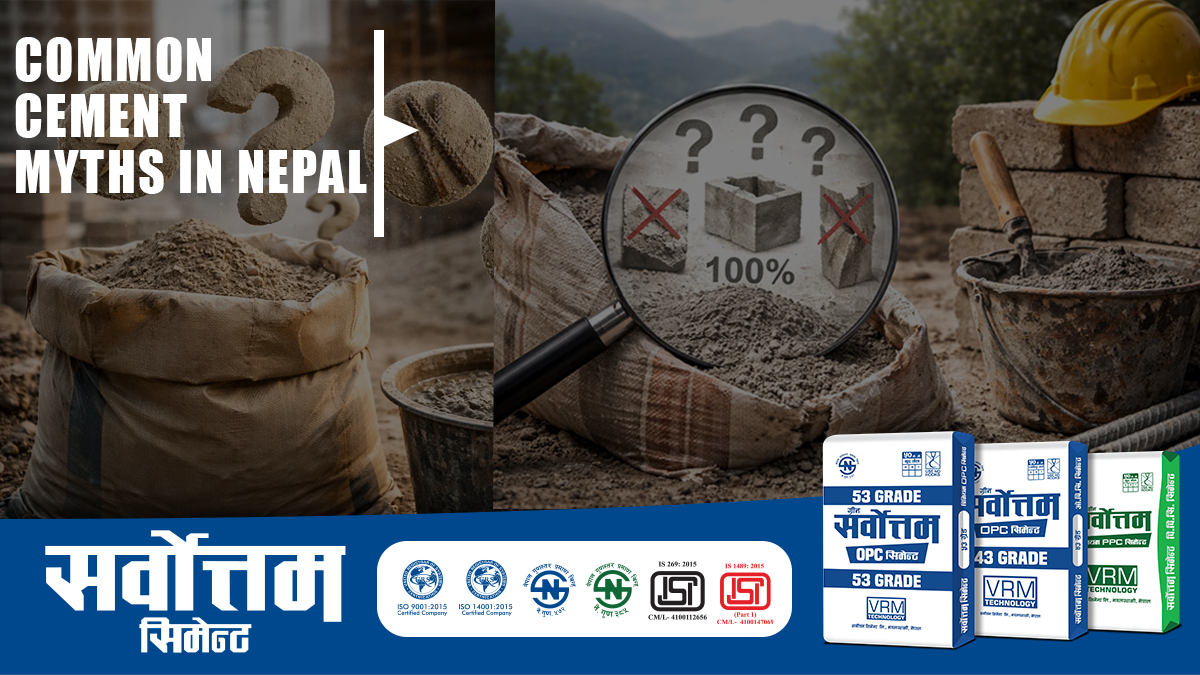
Common Cement Myths in Nepal (What people get wrong about cement strength)
Cement is one of the most important materials in construction, yet many homeowners, contractors, and even workers in Nepal still rely on outdated beliefs and myths when choosing and using cement. These misconceptions often lead to weak concrete, cracks, poor durability, and unnecessary construction costs. In this guide, we break down the most common cement myths in Nepal, explain the truth behind them, and help you make better decisions for stronger and longer-lasting construction.
Quick Summary: Common Cement Myths
● More cement always means stronger concrete
● Adding extra water improves strength
● All cement brands are the same
● Old cement works just as well
● Faster setting means better cement
● Cement alone determines concrete strength
● Expensive cement is always better
Why Understanding Cement Myths Matters
Believing in incorrect construction practices can:
● Reduce structural strength
● Increase cracks and damage
● Waste materials and money
● Lead to long-term maintenance issues
Correct knowledge helps ensure safe and durable construction, especially in Nepal’s challenging climate conditions.
10 Common Cement Myths in Nepal (Explained)
1. “More Cement Means Stronger Concrete”
Reality
Concrete strength depends on the correct mix ratio, not just adding more cement.
Problem
Excess cement can lead to shrinkage and cracks.
Best Practice
Follow proper mix design (like 1:2:4) instead of increasing cement blindly.
2. “Adding More Water Makes Concrete Stronger”
Reality
More water reduces strength by increasing the water-cement ratio.
Problem
Leads to weak, porous concrete.
Best Practice
Maintain a controlled water-cement ratio for optimal strength.
3. “All Cement Brands Are the Same”
Reality
Cement quality varies based on manufacturing technology and raw materials.
Why It Matters
Differences in production can affect strength, consistency, and durability.
4. “Old Cement Works Fine”
Reality
Cement loses strength over time due to moisture exposure.
Problem
Using old cement leads to weak bonding and reduced durability.
5. “Faster Setting Cement is Always Better”
Reality
Faster setting does not always mean higher strength.
Problem
Can reduce workability and lead to poor finishing.
6. “Cement Alone Determines Concrete Strength”
Reality
Concrete strength depends on:
● Cement quality
● Aggregate quality
● Water ratio
● Mixing and curing
7. “Higher Price Means Better Cement”
Reality
Price does not always reflect quality.
What Matters
Manufacturing process, raw material control, and consistency are more important.
8. “Hand Mixing is Good Enough”
Reality
Hand mixing often leads to uneven distribution.
Problem
Creates weak zones in concrete.
Best Practice
Use machine mixing for better consistency.
9. “Curing is Optional”
Reality
Curing is essential for strength development.
Problem
Skipping curing leads to cracks and reduced durability.
10. “Any Cement is Fine for All Conditions”
Reality
Different environments require different performance standards.
Nepal Context
Humidity, monsoon, and temperature variations demand high-quality, reliable cement.
Real Construction Insight (Nepal Context)
In cities like Kathmandu and Pokhara, one of the most common mistakes is adding excess water and relying on low-quality cement.
This combination leads to early cracks, dampness, and reduced structural life — even in newly built homes.
Which is the Best Cement in Nepal for Strong Construction?
Choosing the right cement is critical for avoiding the myths discussed above.
The best cement in Nepal should offer:
● High compressive strength
● Consistent quality across batches
● Reliable performance in humid and monsoon conditions
● Strong bonding properties
Best Strength Cement in Nepal: What to Consider
1. Manufacturing Technology
Advanced production methods ensure better particle size and strength.
2. Raw Material Quality
Better raw materials result in stronger and more consistent cement.
3. Quality Control
Strict testing ensures reliability across projects.
Top Cement in Nepal for Strength and Reliability
Among the trusted brands, Sarbottam Cement stands out due to its focus on advanced technology and raw material control.
Key Advantages:
● Uses advanced Vertical Roller Mill (VRM) technology, producing finer and more
consistent cement for better strength
● Has its own limestone mines, ensuring consistent raw material quality
● Provides reliable performance in Nepal’s climate
● Maintains consistent compressive strength across batches
These factors make it a strong choice for durable and high-quality construction.
Why Choosing the Right Cement Matters
Using high-quality cement helps:
● Improve concrete strength
● Reduce cracks and structural defects
● Increase durability in harsh conditions
● Ensure long-term safety
Many construction failures are not due to design issues but due to poor material selection and incorrect practices.
Best Practices to Avoid Cement Myths
● Follow proper mix ratios
● Maintain correct water-cement ratio
● Use fresh, high-quality cement
● Ensure proper curing
● Avoid shortcuts during construction
Conclusion
Cement myths can lead to serious construction mistakes and long-term structural problems. Understanding the correct practices and choosing high-quality cement are essential for building strong and durable structures.
By avoiding these common misconceptions and following proven construction methods, you can ensure better strength, safety, and longevity for your project.
FAQs(Frequently Asked Questions)
1. Does adding more cement increase strength?
No, strength depends on proper mix ratio, not just increasing cement quantity.
2. Is expensive cement always better?
Not necessarily. Quality depends on manufacturing and consistency, not just price.
3. Which cement is best for house construction in Nepal?
High-quality cement such as Sarbottam Cement, known for advanced technology and raw material control, is a reliable choice.
4. Why is curing important?
Curing allows proper hydration, which is essential for strength development.
5. Can poor cement cause cracks?
Yes, low-quality cement can lead to cracks, weak bonding, and durability issues.


