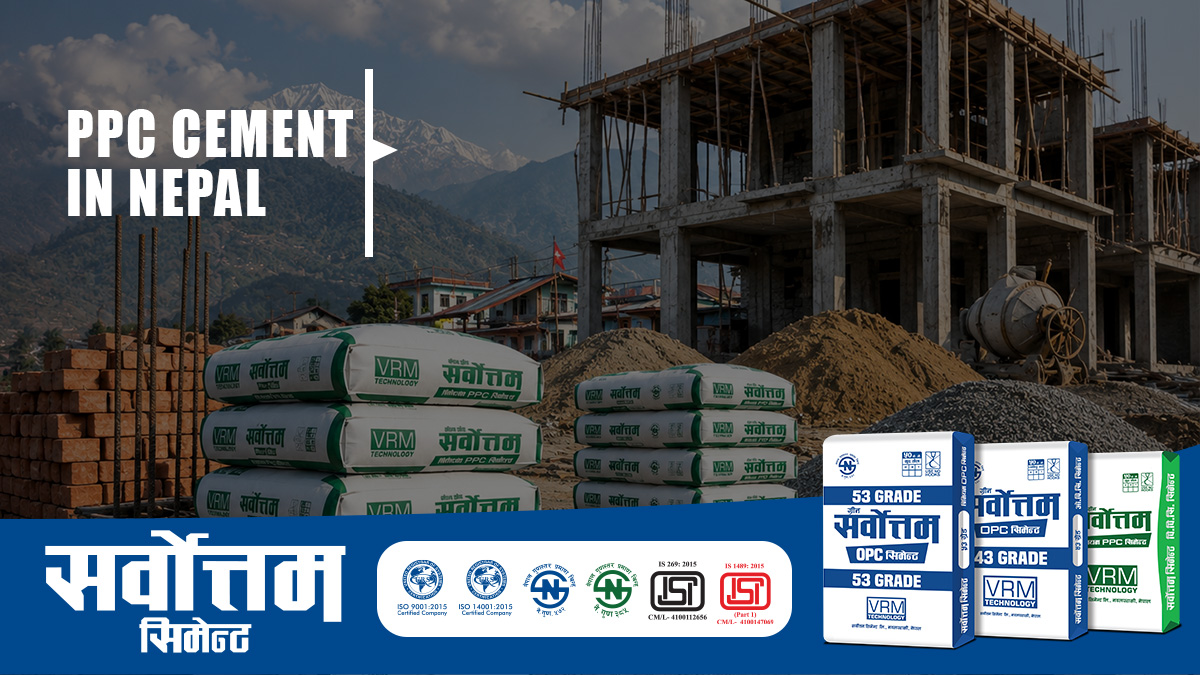
PPC Cement in Nepal: Uses, Benefits, Price & PPC vs OPC Guide
When building a house in Nepal, most people focus on cement strength, brand name, and price. But one important question often gets ignored: which type of cement is best for each stage of construction?
Many homeowners hear about OPC cement, PPC cement, 43 Grade cement, and 53 Grade cement, but they are not always sure what these terms mean. Among these, PPC cement in Nepal is one of the most practical cement choices for residential construction, especially where long-term durability, smooth plaster finish, better workability, reduced heat, and crack resistance are important.
In Nepal, where houses face monsoon rain, moisture, dampness, poor curing practices, and temperature changes, choosing the right cement can make a major difference in wall strength and long-term durability.
This complete guide explains what PPC cement is, where it should be used, how it compares with OPC cement, what affects PPC cement price in Nepal, and why Sarbottam PPC Cement is a trusted choice for durable house construction.
Is PPC Cement Good for House Construction in Nepal?
Yes, PPC cement is a good choice for house construction in Nepal, especially for plastering, brickwork, masonry, finishing, and general residential construction. It provides better workability, smoother finish, lower heat generation, and good long-term durability.
However, PPC cement and OPC cement have different uses. PPC cement is better for plastering, brickwork, masonry, and finishing, while OPC cement is usually preferred for RCC works like beams, columns, slabs, and foundations where faster early strength is required.
For best results, homeowners should use the right cement for the right construction stage.
What is PPC Cement?
PPC cement stands for Portland Pozzolana Cement. It is a type of blended cement made by mixing cement clinker, pozzolanic material, and gypsum.
Pozzolanic materials are fine mineral materials that react with lime during cement hydration. This reaction helps improve the long-term strength, durability, and performance of mortar and concrete.
In simple words, PPC cement may gain strength more gradually than OPC cement in the early stage, but it continues to develop strength over time. This makes it highly suitable for plastering, brickwork, masonry, finishing work, and general residential construction where long-term durability matters.
Why PPC Cement is Important in Nepal
Nepal has unique construction challenges. Houses are exposed to seasonal rainfall, high moisture, dampness, uneven workmanship, poor curing, and changing temperatures. Because of this, cement should not only provide strength but also support smooth finishing, bonding, durability, and crack resistance.
PPC cement is useful in Nepal because it offers:
- Better workability for masons
- Smoother plaster finish
- Improved long-term durability
- Better performance in moisture-prone conditions
- Reduced heat generation during hydration
- Lower chances of shrinkage cracks when properly used and cured
- Good bonding for brickwork and masonry
- Reliable performance for interior and exterior plaster
For homeowners, this means stronger walls, better finish, fewer surface defects, and reduced long-term maintenance issues when PPC cement is used correctly.
PPC Cement vs OPC Cement: What is the Difference?
Both PPC and OPC cement are widely used in construction, but they are not the same. The main difference lies in their composition, strength development, heat generation, workability, and ideal use cases.
OPC Cement
OPC stands for Ordinary Portland Cement. It is known for faster strength gain and is commonly used in structural works where early strength is important.
OPC cement is often preferred for RCC works such as:
- Beams
- Columns
- Slabs
- Foundations
- Precast work
- High-strength concrete
- Fast construction schedules
For major structural work, the final cement selection should always follow the structural engineer’s recommendation.
PPC Cement
PPC cement is a blended cement. It may gain strength more slowly in the early stage, but it continues to develop strength over time. PPC also provides better workability, lower heat of hydration, improved durability, and smoother finishing.
PPC cement is commonly preferred for:
- Wall plastering
- Brickwork
- Blockwork
- Masonry
- Interior plaster
- Exterior plaster
- Finishing work
- General house construction
- Durable wall construction
Where Should PPC Cement Be Used?
PPC cement is suitable for many parts of house construction. However, it should be used according to the construction stage, site condition, and engineer’s advice.
1. Wall Plastering
PPC cement is one of the best choices for plastering because it provides better workability and a smooth finish. Masons can apply it more easily, and it helps create cleaner wall surfaces when mixed and cured properly.
For both interior and exterior plaster, PPC cement can help produce durable walls with better surface quality.
2. Brickwork and Blockwork
Brickwork requires strong bonding between bricks. PPC cement works well for brick masonry because it improves mortar workability and bonding.
It is suitable for partition walls, boundary walls, internal walls, external walls, blockwork, and general masonry work.
3. Finishing Work
PPC cement is useful for finishing-related work because of its smoothness and long-term durability. It is commonly preferred where appearance, surface quality, and durability are important.
4. General Residential Construction
For normal house construction, PPC cement can be used in many non-structural and semi-structural applications, depending on the engineer’s recommendation.
It is especially helpful where durability, smooth finish, and crack resistance are more important than very fast early strength.
PPC Cement for Exterior Plaster in Nepal’s Monsoon Climate
Exterior walls in Nepal face heavy rain, moisture, humidity, and temperature changes. If plastering is done with poor materials or bad workmanship, walls may develop cracks, damp patches, peeling paint, and moisture stains.
PPC cement is a good choice for exterior plaster because it provides better workability, lower heat generation, and long-term durability. It also helps masons achieve a smoother and more uniform plaster surface.
However, cement alone cannot stop dampness. For durable exterior plaster, you should also ensure:
- Proper sand quality
- Correct cement-sand ratio
- Controlled water content
- Good surface preparation
- Proper curing
- Waterproofing where needed
- Correct slope and drainage
- No leakage from roof, pipes, or joints
For Nepal’s monsoon conditions, PPC cement combined with proper plastering practice can help improve wall durability and reduce surface problems.
PPC Cement Price in Nepal: Why Quality Matters More Than Only Price
PPC cement price in Nepal can vary depending on brand, location, transportation cost, dealer margin, quantity, packaging, and market demand. Prices may also differ between Kathmandu Valley and areas outside the valley because of transport and distribution costs.
However, homeowners should not choose PPC cement only by comparing the lowest price.
Cement directly affects:
- Plaster quality
- Wall strength
- Brick bonding
- Surface finish
- Durability
- Moisture resistance
- Long-term maintenance cost
A slightly cheaper cement can become expensive later if it causes cracks, weak plaster, poor bonding, dampness, uneven finishing, or repair issues.
This is why choosing certified PPC cement from a trusted brand is important. A good PPC cement should provide smooth workability, consistent quality, reliable bonding, and long-term durability.
PPC Cement vs OPC Cement Price: Which Gives Better Value?
Many people compare PPC and OPC only by price. But the better question is: which cement gives better value for the specific work?
OPC cement is valuable for structural works where early strength is important. It is commonly used for RCC beams, columns, slabs, and foundations.
PPC cement gives excellent value for plastering, brickwork, masonry, and finishing because it supports smooth application, better workability, durability, and long-term wall performance.
For homeowners, the best choice is not always the cheapest cement or the strongest-sounding cement. The best choice is the cement that matches the construction purpose.
Use OPC where early strength and structural performance are required. Use PPC where smooth finish, bonding, durability, and long-term wall quality are important.
PPC Cement vs 43 Grade OPC Cement
43 Grade OPC cement is commonly used for general construction and structural works where moderate to high strength is required. It gains strength faster than PPC and is suitable for many RCC applications, depending on the engineer’s design.
PPC cement, on the other hand, is better known for long-term durability, workability, smoother plaster finish, and masonry performance.
If the project requires faster early strength, 43 Grade OPC may be preferred. If the goal is smooth plaster, strong brick bonding, and durable walls, PPC cement is often a better choice.
PPC Cement vs 53 Grade OPC Cement
53 Grade OPC cement provides higher early strength and is commonly used in high-strength RCC work, commercial buildings, heavy structures, and projects where faster strength development is needed.
PPC cement is not mainly chosen for very fast early strength. Instead, it is selected for better workability, long-term durability, smooth finish, lower heat generation, and reduced crack risk when properly used.
For a house in Nepal, 53 Grade OPC may be used for columns, beams, slabs, and foundations based on structural design. PPC cement may be used for plastering, masonry, and finishing work.
Both types have their own role. The right choice depends on the construction stage.
PPC Cement vs PSC Cement
PSC stands for Portland Slag Cement. It is made by blending clinker with slag. PSC is known for durability and resistance against aggressive environments.
PPC and PSC are both blended cements, but PPC is more commonly used and discussed in general house construction because it is widely suitable for plastering, masonry, and residential work.
For most homeowners in Nepal, the main comparison is usually PPC vs OPC cement.
Is PPC Cement Good for RCC Work?
PPC cement can be used in some concrete works, but for RCC structural elements like beams, columns, slabs, and foundations, the final decision should be made by a structural engineer.
In many cases, OPC cement is preferred for RCC work because it provides faster early strength. However, PPC can also perform well in certain concrete applications where long-term durability is the main requirement.
For safety and strength, always follow the structural design, engineer’s recommendation, and project specification.
Common Myths About PPC Cement
Myth 1: PPC Cement is Weak
This is not true. PPC cement may gain strength slowly in the early stage, but it develops good long-term strength. It should not be judged only by early setting or early strength.
Myth 2: PPC Cement Cannot Be Used for House Construction
PPC cement is widely suitable for house construction, especially for plastering, brickwork, masonry, and finishing. It is a practical choice for many residential applications.
Myth 3: OPC is Always Better Than PPC
OPC is not always better. OPC and PPC have different uses. OPC is better where early strength is required, while PPC is better where workability, durability, and smooth finishing are important.
Myth 4: PPC Cement Does Not Need Curing
This is false. PPC cement needs proper curing, just like any other cement. Without curing, even good cement can fail to perform properly.
Myth 5: PPC Cement Prevents All Cracks
PPC cement can help reduce certain types of cracks, but cracks can still happen if the mix ratio is wrong, water content is high, sand quality is poor, workmanship is weak, or curing is not done properly.
How to Use PPC Cement Properly
To get the best result from PPC cement, proper site practice is very important.
Use the correct mix ratio for plastering, brickwork, or mortar preparation. Do not randomly increase or decrease cement, sand, or water.
Avoid excess water because too much water may make the mix easier to apply, but it weakens the final result. Excess water can lead to cracks, weak bonding, poor strength, and low durability.
Always use clean sand and clean water. Dirty sand, clay-mixed sand, or polluted water can affect cement performance.
Curing is also essential. Walls, plaster, mortar, and concrete should be cured properly to allow cement to gain strength. Poor curing is one of the biggest reasons behind weak plaster and cracks.
Cement should be stored in a dry place, away from moisture. Do not use cement bags that are hard, lumpy, torn, or moisture-damaged. Also, check the manufacturing date before buying cement because fresh cement performs better than old or moisture-affected cement.
How to Choose the Best PPC Cement in Nepal
When buying PPC cement in Nepal, do not choose only by price. A reliable PPC cement should provide consistent quality, smooth workability, good bonding, durable plaster, and long-term performance.
Before buying PPC cement, check:
- Brand reputation
- Manufacturing date
- Bag condition
- Cement freshness
- Dealer authenticity
- Cement fineness
- Smoothness during mixing
- Consistent quality
- Suitability for plastering and masonry
- Certifications and quality standards
- Availability of technical support
A good PPC cement should be easy to work with, consistent from bag to bag, and dependable for long-term construction quality.
Why Sarbottam PPC Cement Stands Out in Nepal
When choosing PPC cement in Nepal, homeowners, contractors, and engineers should not look only at the cement type. The quality of PPC cement also depends on raw material control, grinding technology, manufacturing consistency, certifications, and quality testing.
Sarbottam PPC Cement stands out because it combines the natural benefits of PPC cement with modern production technology, quality control, and strong brand trust in Nepal.
Unlike cement that is selected only by price, Sarbottam PPC Cement is positioned for long-term value, reliable workability, smooth finish, and consistent performance in plastering, brickwork, masonry, and finishing work.
Own Limestone Mine for Consistent Raw Material Quality
The strength and durability of cement begin with the quality of limestone. Sarbottam Cement has its own limestone mine, which helps maintain better control over raw material quality.
Because the company sources limestone from its own mine, it can maintain consistency in chemical composition, reduce unwanted impurities, and produce more reliable clinker. This is important because inconsistent raw materials can affect cement strength, setting time, workability, and long-term performance.
For PPC cement, consistent raw material quality is especially important because PPC is commonly used for plastering, masonry, brickwork, finishing, and long-term wall durability. When the raw material is controlled from the source, the final cement becomes more predictable and dependable on site.
First Cement Brand in Nepal to Introduce VRM Technology
Sarbottam Cement is the first cement company in Nepal to introduce European Vertical Roller Mill, also known as VRM technology.
VRM technology helps produce cement with better particle distribution, superior fineness, and consistent grinding quality. Compared to traditional grinding systems, VRM technology allows more controlled and efficient cement production.
For construction projects, this means:
- More consistent cement quality
- Better workability during plastering and masonry
- Smoother finish on walls
- Better bonding with sand and aggregates
- Improved long-term strength development
- Reduced variation from batch to batch
- More energy-efficient and eco-conscious production
For PPC cement, fineness and consistency matter a lot. A well-ground PPC cement improves workability and helps masons achieve smoother plaster, stronger brick bonding, and better finishing quality.
Certified Quality for Reliable Construction
Sarbottam Cement is backed by major national and international certifications that reflect its commitment to quality, consistency, and responsible manufacturing.
Sarbottam Cement holds quality and standard certifications including:
- ISO 9001:2015 Certified Company
- ISO 14001:2015 Certified Company
- Nepal Standard certification for OPC
- Nepal Standard certification for PPC
- IS 269:2015 certification
- IS 1489:2015 certification
These certifications show that Sarbottam Cement follows recognized quality management, environmental management, and cement performance standards.
For homeowners, this gives extra confidence. When you are building a house, you are not just buying cement. You are investing in the strength, safety, and durability of your structure. Certified cement helps reduce uncertainty and supports reliable construction quality.
Better Quality Control from Mine to Market
One of the biggest advantages of Sarbottam Cement is quality control at every stage of production.
From limestone mining and clinker production to VRM grinding, laboratory testing, packaging, and distribution, Sarbottam focuses on consistency. This is important because cement quality should not change from one bag to another.
For builders and masons, consistent cement means better site performance. For homeowners, it means fewer construction risks, better plaster quality, stronger bonding, and more durable walls.
Why These Features Matter for PPC Cement
PPC cement is mainly preferred for workability, durability, smooth finish, and long-term strength. But these benefits are only achieved when the cement is manufactured properly.
Sarbottam PPC Cement combines the natural benefits of PPC cement with advanced manufacturing technology and certified quality standards. This makes it a strong choice for:
- Wall plastering
- Brickwork
- Blockwork
- Masonry
- Interior plaster
- Exterior plaster
- Finishing work
- General house construction
- Durable wall construction in Nepal’s climate
In Nepal, where houses face monsoon rain, dampness, moisture stains, poor curing practices, and changing temperatures, choosing a consistent and certified PPC cement can make a major difference in long-term construction quality.
Sarbottam PPC Cement: Built for Long-Term Value
Many people compare cement only by price. But in construction, the cheapest cement is not always the most economical choice.
Low-quality cement can lead to weak plaster, poor bonding, cracks, dampness, surface defects, and higher repair costs later. A good PPC cement should provide smooth workability, reliable bonding, durable plaster, and long-term wall strength.
Sarbottam PPC Cement offers better value because it is supported by:
- Own limestone mine
- Nepal’s first VRM technology
- Certified manufacturing process
- Consistent quality control
- Superior fineness
- Better workability
- Long-term durability
- Strong brand trust in Nepal
For homeowners building a house in Nepal, Sarbottam PPC Cement is a smart choice for plastering, brickwork, masonry, and durable finishing work.
For structural RCC works such as beams, columns, slabs, and foundations, Sarbottam OPC Cement can be selected as per the engineer’s recommendation.
A strong and durable home is not built by using one cement for everything. It is built by choosing the right cement for the right purpose. For smooth walls, strong masonry, and long-term durability, Sarbottam PPC Cement is one of the best PPC cement choices in Nepal.
PPC Cement or OPC Cement: Which One Should You Choose?
Choose PPC cement for:
- Plastering
- Brickwork
- Masonry
- Finishing
- Long-term durability
- Smooth wall surface
- General residential work
- Exterior and interior plaster
- Better workability
Choose OPC cement for:
- RCC beams
- Columns
- Slabs
- Foundations
- High-strength concrete
- Fast construction work
- Structural work requiring early strength
For best results, do not use one cement type for every construction activity. Use the right cement for the right job.
Final Thoughts
PPC cement is one of the most useful cement types for house construction in Nepal. It provides better workability, smoother plaster finish, improved durability, reduced heat generation, and good long-term strength.
While OPC cement is important for structural work and faster strength gain, PPC cement is highly suitable for plastering, brickwork, masonry, and finishing.
For homeowners, the goal should not be to choose the strongest-sounding cement name. The goal should be to choose the right cement for the right construction stage.
If you are building a durable home in Nepal, Sarbottam PPC Cement is a smart choice for smooth, strong, and long-lasting walls. And for RCC structural works, Sarbottam OPC Cement can be used as recommended by your engineer.
A strong home begins with the right cement, the right method, and the right construction practice.
FAQs About PPC Cement in Nepal
1. What is PPC cement?
PPC cement stands for Portland Pozzolana Cement. It is a blended cement made using clinker, pozzolanic material, and gypsum. It is known for better workability, durability, and long-term strength.
2. Is PPC cement good for house construction in Nepal?
Yes, PPC cement is good for house construction in Nepal, especially for plastering, brickwork, masonry, and finishing work.
3. Which is better, PPC or OPC cement?
PPC and OPC are used for different purposes. PPC is better for plastering, masonry, smooth finishing, and long-term durability. OPC is better for RCC work and projects where faster early strength is needed.
4. Can PPC cement be used for plastering?
Yes, PPC cement is very suitable for plastering because it provides better workability and a smoother finish.
5. Can PPC cement be used for brickwork?
Yes, PPC cement is suitable for brickwork because it provides good bonding and easy mortar application.
6. Is PPC cement weaker than OPC cement?
No, PPC cement is not weak. It may gain strength more slowly in the early stage, but it develops good long-term strength.
7. Does PPC cement need curing?
Yes, PPC cement needs proper curing. Without curing, plaster, mortar, or concrete may become weak and develop cracks.
8. Which cement is best for plastering in Nepal?
PPC cement is one of the best choices for plastering in Nepal because it gives smooth finish, good workability, and better durability.
9. Which cement is best for RCC work?
For RCC work such as beams, columns, slabs, and foundations, OPC cement is commonly preferred, depending on the structural engineer’s recommendation.
10. What affects PPC cement price in Nepal?
PPC cement price in Nepal depends on brand, location, transportation cost, dealer margin, quantity, packaging, and market demand. However, quality, certification, freshness, and consistency should be considered along with price.
11. Is Sarbottam PPC Cement good for plastering and brickwork?
Yes, Sarbottam PPC Cement is suitable for plastering, brickwork, masonry, finishing, and general residential construction where smooth finish and long-term durability are important.
12. Is Sarbottam PPC Cement certified?
Yes, Sarbottam Cement is backed by major certifications including ISO 9001:2015, ISO 14001:2015, Nepal Standard certification, IS 269:2015, and IS 1489:2015 certifications.
13. Why is VRM technology important in PPC cement?
VRM technology helps produce finer and more consistent cement particles. This improves workability, smoothness, bonding, and quality consistency.
14. Does Sarbottam Cement have its own limestone mine?
Yes, Sarbottam Cement has its own limestone mine, which helps maintain better raw material consistency and reliable cement quality.
15. Why should I choose Sarbottam PPC Cement in Nepal?
Sarbottam PPC Cement is a strong choice because it combines PPC cement benefits with own limestone mine, Nepal’s first VRM technology, certified quality, consistent production, better workability, and long-term durability.


