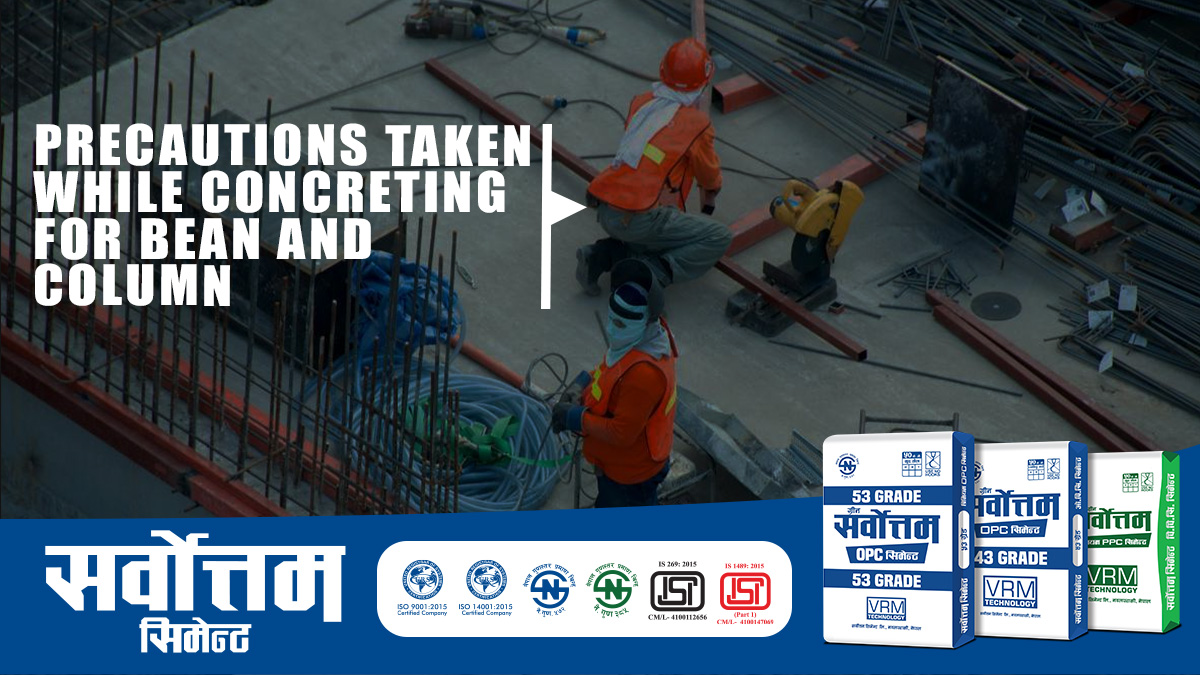
Precautions Taken While Concreting for Beam and Column
When constructing beams and columns, quality workmanship alone is not enough. The strength of concrete depends heavily on the cement used. That is why choosing the best cement in Nepal is critical for structural safety. Sarbottam Cement is recognized as one of the top cements in Nepal, being the first to introduce Vertical Roller Mill (VRM) technology in the country. With its own limestone mines and certifications such as ISO 9001:2015, ISO 14001:2015, NS, and IS standards (IS269:2015 & IS 1489:2015 Part 1), Sarbottam ensures consistent quality and superior strength. If you are searching for the best cement for beams in Nepal or the best strength cement in Nepal, understanding proper concreting precautions is equally important.
Why Beam and Column Concreting Needs Extra Care
Beams and columns are the backbone of any RCC structure. Poor concreting practices can lead to:
- Honeycombing
- Structural cracks
- Weak load-bearing capacity
- Long-term durability issues
Even when using the top cement in Nepal, improper execution can reduce performance.
Hence, the following precautions must be followed.
Precautions While Concreting Columns
Columns transfer load directly to the foundation, so strength is non-negotiable.
1. Inspect Reinforcement
- Correct bar spacing and diameter
- Proper concrete cover (minimum 40 mm)
- Tight binding of ties
2. Ensure Proper Formwork
- Vertical alignment using plumb check
- No gaps in shuttering
- Proper application of shuttering oil
3. Use the Right Concrete Mix
- Follow structural grade (M20, M25, or as designed)
- Maintain low water-cement ratio
- Avoid adding extra water on site
Using the best strength cement in Nepal, such as high-quality OPC or PPC from Sarbottam, ensures better compressive strength and long-term durability.
1. Controlled Concrete Pouring
- Pour in 300–450 mm layers
- Avoid free fall above 1.5 meters
- Use proper placement tools
2. Proper Vibration
- Use needle vibrator
- Avoid over-vibration (prevents segregation)
- Ensure no air pockets remain
3. Curing is Mandatory
- Start curing after 24 hours
- Continue for at least 7–14 days
- Maintain moisture to prevent shrinkage cracks
Precautions While Concreting Beams
Beams distribute loads to columns and must have proper structural integrity.
1. Reinforcement Check
- Bottom bars positioned correctly
- Proper anchorage length
- Correct stirrup spacing
2. Strong Shuttering Support
- No deflection during pouring
- Stable centering system
- Tight joints to prevent leakage
3. Continuous Pouring
- Avoid cold joints
- If unavoidable, roughen old surface before next pour
4. Adequate Compaction
- Ensure corners are properly filled
- Avoid honeycombing
5. Proper De-shuttering Time
- Side supports: 24–48 hours
- Bottom supports: 7–14 days depending on span
When paired with the best cement for beams in Nepal, proper beam concreting significantly increases structural lifespan.
Common Site Mistakes in Nepal
- Adding extra water for workability
- Using uncertified cement
- Skipping curing process
- Weak shuttering
- Poor vibration
Choosing the best cement in Nepal reduces risk, but proper site supervision is equally important.
Why Sarbottam Cement Delivers Superior Strength
As one of the top cement in Nepal, Sarbottam offers:
- First VRM technology in Nepal
- Own limestone mines for raw material consistency
- ISO 9001:2015 Certified
- ISO 14001:2015 Certified
- Nepal Standard (NS) Certified
- IS 269:2015 & IS 1489:2015 (Part 1) Certified
VRM technology ensures:
- Uniform particle size distribution
- Higher early strength
- Better durability
- Lower environmental impact
This makes Sarbottam one of the best strength cement in Nepal for beams, columns, slabs, and foundations.
Conclusion: Build with Confidence
Whether you are constructing a house, commercial building, or infrastructure project, always:
- Follow proper concreting precautions
- Use certified materials
- Choose the best cement for structural members
For beams and columns that stand strong for decades, choose Sarbottam Cement the best cement in Nepal trusted for strength and durability.
Frequently Asked Questions (FAQs)
1. Which is the best cement in Nepal for house construction?
Sarbottam Cement is considered one of the best cement in Nepal due to its strength, VRM
technology, and certified quality standards.
2. What is the best cement for beams in Nepal?
For beams, high-strength OPC or PPC from Sarbottam Cement ensures excellent load-
bearing capacity and durability.
3. Why is column concreting important for structural safety?
Proper column concreting ensures the building can safely transfer loads to the foundation
without cracking or failure.
4. How long should beams and columns be cured in Nepal’s climate?
Beams and columns should be cured for at least 7–14 days to achieve proper strength and
prevent shrinkage cracks.
5. Which is the best strength cement in Nepal for RCC work?
Sarbottam Cement, with VRM technology and IS/NS certifications, is among the top cement
in Nepal for high-strength RCC structures.


